
- PORT FOURCHON, Louisiana: British Petroleum reported progress on Friday in its struggle to shut off its gushing Gulf of Mexico oil well as President Barack Obama sought to show leadership in tackling the biggest spill in US history.
Obama visited the Louisiana coast, where sticky oil has permeated wetlands, closed down the lucrative fishing trade and angered locals whose communities are still recovering from Hurricane Katrina in 2005.
BP Chief Executive Tony Hayward said the so-called “top kill” procedure, in which heavy drilling “mud” is pumped into the seabed well shaft, was showing some signs of success in choking off the leak that has already spewed millions of gallons of oil into the Gulf.
But the success of the operation, never attempted at such depths, was still uncertain and it could be another 48 hours before it would be known whether it was successful, he said.
“We don't know whether we will be able to overcome the well,” Hayward told NBC’s “Today” show. The British-based energy giant was maintaining its assessment that the “top kill” plugging operation had a 60 to 70 percent chance of success.
The spill is a major challenge for Obama.
Opinion polls show many Americans are dissatisfied with Obama’s handling of the five-week-old crisis. He was on the defensive at a news conference on Thursday, rebutting criticism that his administration had been too slow to act and too quick to believe what it was being told by BP.
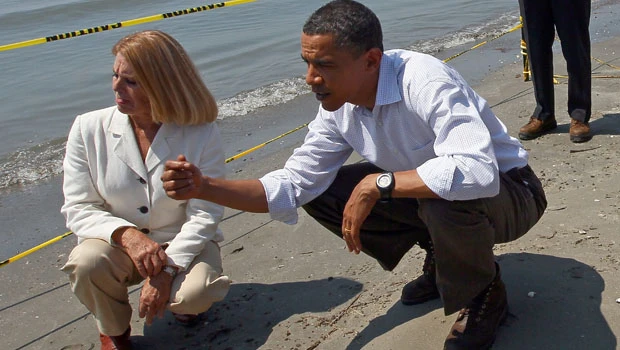
On his visit to the Gulf coast, Obama inspected oil-trapping booms at a beach in Port Fourchon, the hub of the Gulf oil industry and one of the areas worst affected by crude coming ashore from the spreading spill. “Obviously, the concern is that until we stop the flow, we’ve got problems,” said Obama, picking up several tar balls from the beach. An array of oil rigs could be seen off-shore. Hayward said BP engineers had injected a “junk shot” of heavier blocking materials — such as pieces of rubber — into the failed blowout preventer of the ruptured wellhead.
“We have some indications of partial bridging which is good news,” he told CNN. “I think it's probably 48 hours before we have a conclusive view,” he added.
Thad Allen, a Coast Guard admiral who is leading the oil spill response, told ABC: “We're very encouraged by the fact that they're able to push the mud down. The real question is can we sustain it, and that will be the critical issue going through the next 12 to 18 hours.”
BP shares were down around 5 percent in London amid uncertainty over the success of the effort to plug the well. BP said on Friday the cost of the disaster so far was $930 million. The cost is sure to multiply with cleanup of the oily mess, which is now larger than the spill from the Exxon Valdez disaster off the Alaskan coast in 1989.
“This is clearly an environmental catastrophe. There are no two ways about it,” Hayward told CNN, reversing previous comments in which he had minimized the spill's ecological impact. Friday's trip was Obama's second to the Gulf in the more than five weeks since a rig explosion killed 11 workers and unleashed the oil from a well head a mile undersea.
His tour comes a day after he vowed to “get this fixed” as criticism swelled over what many Americans see as a slow government response to one of the country's biggest environmental disasters.
Obama's predecessor, George W. Bush, was slammed for his administration's handling of Hurricane Katrina and Obama is anxious to avoid comparisons.
The spill could turn into a major political liability for Obama before November elections that are widely expected to erode his Democratic Party's control of the US Congress.
At the White House on Thursday, Obama took ownership of the crisis, in a shift from earlier statements in which he placed all the responsibility for cleaning up the mess on the shoulders of BP.