- SARDIHA, India: Railway authorities canceled all night trains in an eastern Indian state Saturday after a passenger express train derailed and was hit by a cargo train, killing at least 120 people and injuring hundreds.
The government accused Maoist rebels of sabotaging the tracks.
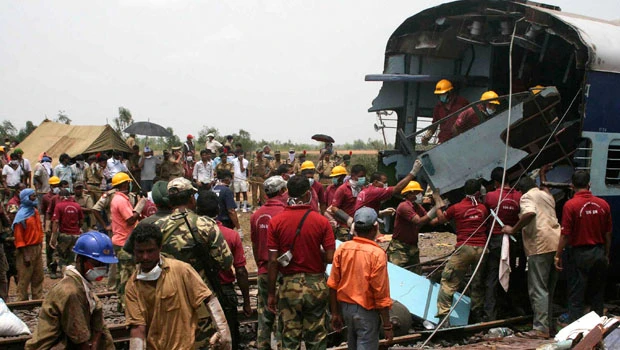
Railway workers and paramilitary soldiers used cranes to lift and pry apart train cars to pull out more bodies from the Jnaneswari Express, which was heading from Kolkata to Mumbai when it derailed early Friday.
"The death toll has now reached 120," Srikumar Mukherjee, West Bengal' civil defense minister, said. A badly crushed carriage was yet to be fully searched and some 40 passengers were still unaccounted for as rescuers suspended operations for the day due to heavy rains, said Mukherjee, who is overseeing rescue operations at the crash site near the small town of Sardiha, about 150 km west of Kolkata in West Bengal state.
More than 140 people with injuries were in hospitals in towns near the accident site, officials said.
Railway officials said some bodies were still trapped between the engines of the two trains, which smashed together when the high speed passenger train derailed and was run over by an oncoming cargo train.
Railway authorities said they would not run any trains at night in West Bengal for at least the next four days, when Indian Maoist rebels have called a general strike.
The area is a stronghold of the rebels, who have launched repeated and often-audacious attacks in recent months despite government claims of a crackdown. Just 11 days ago, the rebels ambushed a bus in central India, killing 31 police officers and civilians. A few weeks before that, 76 soldiers were killed in an ambush — the deadliest attack by the rebels against government forces in the 43-year insurgency. There have been dozens of smaller attacks.
The government vowed once again to crush the Maoists, whom Prime Minister Manmohan Singh has often described as India's biggest internal security challenge. But analysts say the government is hobbled by vacillating policies, poorly trained and ill-armed security forces and vast tracts of India where the government has little influence and where poverty has brought considerable support for the Maoists, who claim to be fighting on behalf of the rural poor.
The rebels, who have tapped into the poor's anger at being left out of the country's economic gains, are now present in 20 of the country's 28 states and have an estimated 10,000 to 20,000 fighters, according to the Home Ministry.
"There is an absence of government. There is an absence of competence in government. There is an absence of coherence in response," said Ajai Sahni, a New Delhi-based analyst with close ties to India's security establishment. "The purpose of the Maoists is not to resolve grievances but to harvest them, and there are numerous grievances in the country to harvest."
In Sardiha, officiails will meet Monday to examine all the evidence from the crash site to determine the cause of the derailment, officials said.
Bhupinder Singh, the top police official in West Bengal, said posters from the People's Committee Against Police Atrocities, a group local officials believe is closely tied to the Maoists, had been found at the scene taking responsibility for the attack.
However, a spokesman for the group, Asit Mahato, denied any role, the Press Trust of India news agency reported.
The Maoists seldom claim credit for their attacks.
Railway Minister Mamata Banerjee said the Sardiha area had been the scene of earlier Naxalite attacks, and that trains were under orders to travel slowly through the region — in part so that drivers can keep watch for sabotaged tracks or bombs, and in part so the effects of a crash are lessened if a train does derail.