
- JEDDAH: Getting private tuition for students, especially girl students, is a big task.
Parents spend much time and energy, and even money, to arrange transport for their wards to commute between their house and the place of tuition.
Jeddah’s Aziziah and Al-Rehab districts bear witness to this. Students carrying notebooks can be seen in the evening in every lane and bylane of this part of the city, which hosts teachers of the large Indian and Pakistani schools.
E-learning is the latest concept to do away with the hassle of commuting, both for tutors and students. Through the Internet, a virtual classroom is created where lesson is given on a one-to-one basis. The teacher and student could be in the same city or thousands of miles away from each other.
Another notable feature is that for e-learning, the student does not have to purchase any software or does not need any special computer skill beyond his or her ability to use a computer to get online.
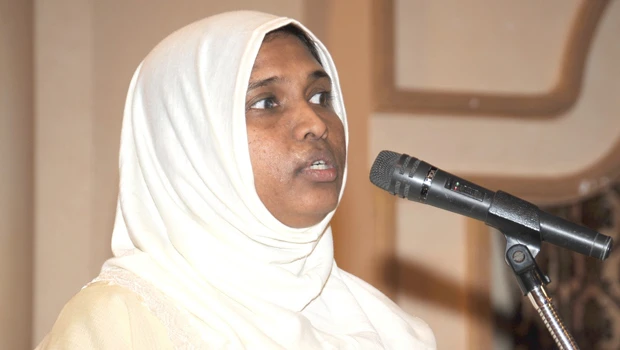
Ameena Aziz is one such tutor who was in Jeddah recently. Currently based in Lucknow in India, she told Arab News her students are spread all over the world — from South Korea to China to Britain to the United States — besides various cities in her own country.
Aziz gives tuition in English while other members of her group of seven give lessons in science subjects, including mathematics. The levels of their students are from standard VII to university. They help even Ph.D. candidates of American universities.
“Ph.D. students send their content and we format it according to their requirement, called APA format. One of my colleagues specializes in this,” said Aziz who was one of the guest speakers at the career guidance program organized by Indian Youth Welfare Association (IYWA) in Jeddah recently.
She also held a workshop at the women’s section of Jeddah’s International Indian School where her colleagues gave a live demonstration from India.
According to Aziz, this concept is gaining popularity in India. But tutors generally do it on an individual basis. Aziz and her colleague have set up a formal group and entered into agreements with a Korean company and a New Delhi-based company. The group gets 250 rupees (SR20) per hour per student from Korea and 500 rupees (SR40) per hour per student from the UK and th US. Currently the group has 170 students.
Aziz said e-lesson is given using writing pads, sketches and optical markers. She also trains tutors in creating virtual classrooms and using a Web-based version of a dry-erase whiteboard.
Aziz said many people in Jeddah have shown interest in her work and have taken her e-mail ID ([email protected]). Laurel, a voluntary organization in Jeddah, working for overall personality development of children, has taken up the cause. Its chief coordinator Khwaja Nasir Jamal has sent mails to prospective parents offering to coordinate between local students and Aziz and her group. He told Arab News that in the typical situation of Jeddah and other Saudi cities the e-learning services should come as a relief to parents of girl students or those living away from the city areas.