
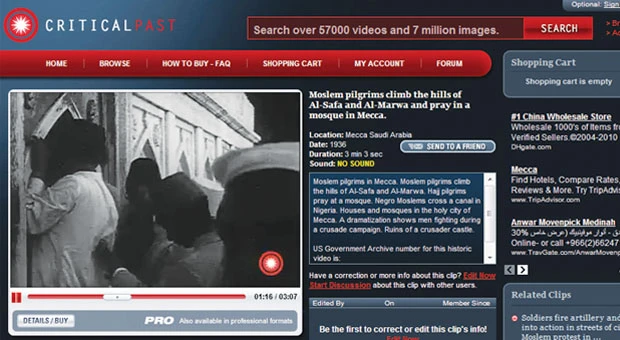
- Critical Past has just launched one of the world’s largest online resources for royalty-free, historic film clips and photos.
- Available now at www.CriticalPast.com, the collection spans thousands of hours of video and millions of still images, all of which are available for free viewing online, or consumers may download the clips for a few dollars.
Critical Past’s archive includes some of history’s most iconic moments from over 4,000 locations worldwide, dating as far back as the 1890s to modern times.
Critical Past’s library of more than 57,000 video clips is drawn from government sources and digitized, making it easy for users to search. Also, as a result of its unique technology, Critical Past has generated a never-before-seen collection of over seven million historic still images, which are created from moving video images at a cadence of one per second.
There are more than 100 clips directly related to Saudi Arabia at the site, with the earliest ones dating from 1916. For instance, footage from 1945 shows the meeting of King Abdulaziz with US President Franklin Roosevelt aboard the USS Quincy (CA-71) at Great Bitter Lake, Suez Canal, during World War II. The clips highlight many aspects of the meeting and it is especially interesting to view Ibn Saud’s sons and the government officials who accompanied him.
There are many film clips of official Saudi visits to the United States. These include King Saud’s trip in 1957, King Faisal’s visit in 1966, and a meeting held by Prince Fahd, later King Fahd, in 1974. Prince Sultan bin Salman is featured from outer space in footage shot during an interview done from Discovery. There are also some surprising scenes from the First Gulf War.
Each video clip on Critical Past is displayed on its own page with related still photo images. Each page has “Related Clips” and “Related Links” tools to assist users in finding related footage on Critical Past, or in further researching a clip’s subject matter through direct links to third-party resources such as Wikipedia and Google Maps. Crowd-sourcing features allow users to provide improvements and additional details for any clip’s description, and discuss any clip with other users in the Critical Past forum.
These last features are important because it is essential that Saudi historians view and comment on some of the earliest clips. Film dating from 1936 shows scenes which might either be staged or the location might be incorrectly attributed. Be advised that some of the captioning in the early silent movies is offensive and reflects the colonial mentality of the time. Nevertheless, the film clips are incredible to watch and demonstrate how modern technology can make exploring the past a fascinating digital adventure.