- TEHRAN/NEW YORK: Iranian President Mahmoud Ahmadinejad said that the new UN sanctions imposed on Tehran on Wednesday should be “thrown in the dustbin,” the ISNA news agency reported.
“These resolutions are not worth a dime for the Iranian nation,” Ahmadinejad told ISNA in Tajikistan. “I gave one of them (world powers) a message that the resolutions you issue are like a used hanky which should be thrown in the dustbin. They are not capable of hurting Iranians.”
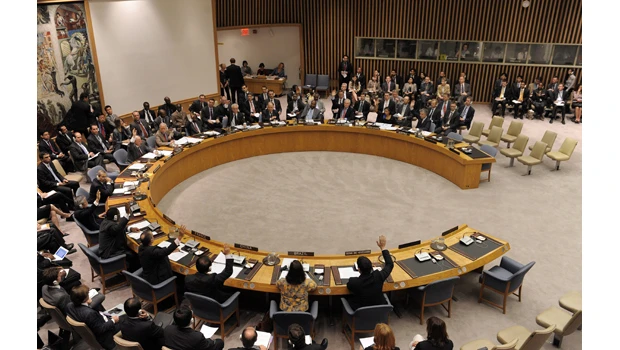
The UN Security Council slapped a fourth set of punitive measures on Iran Wednesday. The vote in the 15-member council was 12 in favor of the US-drafted resolution, with Lebanon abstaining and Brazil and Turkey voting against.
The resolution, cosponsored by Britain and France with the backing of Russia and China, expands an arms embargo and bars the country from sensitive activities like uranium mining.
It authorizes states to conduct high-sea inspections of vessels believed to be ferrying banned items for Iran and adds 40 entities to a list of people and groups subject to travel restrictions and financial sanctions.
US Ambassador to the UN Susan Rice immediately hailed Wednesday’s vote, saying: “The council has risen to its responsibilities. Now Iran should choose a wiser course.” But in Tehran, a Foreign Ministry spokesman slammed the new sanctions as an “incorrect step” that will “complicate” the situation more.
And Iran made it clear through its envoy at the Vienna-based International Atomic Energy Agency that it would not halt uranium enrichment.
China, which voted in favor but was keen to protect its substantial energy and economic interests in Iran, said the resolution aims to coax Iran into returning to the negotiating table and fulfilling its obligations under the nuclear Non-Proliferation Treaty it has signed.
“Sanctions can never fundamentally resolve” the standoff, Chinese Ambassador Li Baodong said, stressing the need to pursue a dialogue with Iran.
The resolution was approved despite the sustained efforts of Brazil and Turkey to head off the measures and promote a nuclear fuel swap deal they reached with Tehran last month.
Under the plan, Iran agreed to ship 1,200 kg of its low-enriched uranium to Turkey in return for high-enriched uranium fuel for a Tehran research reactor that would be supplied later by Russia and France.
The vote was delayed for more than an hour after the ambassadors of Brazil, Turkey and Lebanon, three non-permanent members council members, said they had to await instructions from their governments. The three countries finally decided to attend the meeting, but Brazil and Turkey insisted on speaking before the vote to register their opposition.
“We do not see sanctions as an effective instrument in this case,” Brazil’s Ambassador Maria Luiza Viotti said. She touted the nuclear fuel swap deal as a pathway to a negotiated solution.
But Rice said the deal “does not respond to the fundamental, well-founded, and unanswered concerns about Iran’s nuclear program.”
“The United States reaffirms our commitment to engage in robust, principled, and creative diplomacy. We will remain ready to continue diplomacy with Iran and its leaders to make it clear how much they have to gain from acting responsibly and how much more they stand to lose from continued recklessness,” she added.
The US Congress will pass further sanctions on Iran this month, a key Democratic lawmaker predicted on Wednesday, calling new UN measures a critical step but urging tougher action.
House of Representatives Foreign Affairs Committee Chairman Howard Berman said the United States is looking to key allies in Europe and elsewhere to impose tougher measures to pressure Iran.