
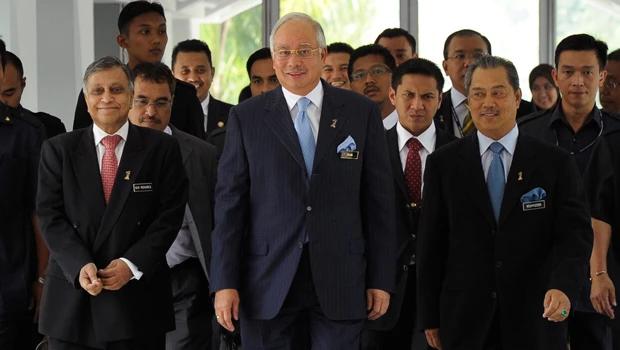
- KUALA LUMPUR: Malaysia on Thursday unveiled a slew of incentives to woo skilled foreign workers and pledged to spend $72 billion on economic development and other programs under a new five-year growth plan.
The measures covering 2011 to 2015 announced by Prime Minister Najib Razak in Parliament are aimed at fulfilling the country's long-standing goal of becoming a developed nation by 2020.
But Malaysia's lack of human capital has often been cited as a key stumbling block, partly due to a brain drain as its controversial affirmative action program for Malays led many citizens to study and work abroad. Also, unlike neighboring Singapore, Malaysia throws up a lot of red tape for hiring high-salaried foreign workers.
"The country is at a critical juncture of its developmental journey and the choice is in our hands, whether to choose the path towards glorious success or the path of decline," Najib said.
"We are akin to being in the last leg of a relay race.
The baton is now in our hands, for us to forge ahead to victory," he said.
Najib said the government will beef up a decades-old affirmative action program to ensure Malays control 30 percent of corporate wealth by 2020, but pledged measures would be market-friendly, transparent and based on merit.
He assured minority Chinese and Indians that they would not be left behind.
"I call upon all Malaysians irrespective of race, religion or political opinion, to work toward ... building a Malaysia where all talent is valued and optimized," he said.
Malays make up about 60 percent of the country's 28 million people but control only 19 percent of its corporate wealth, while ethnic Chinese who are a quarter of the population control 40 percent. Indians control only 1.2 percent of the equity, and foreigners hold the rest.
Najib had earlier pledged to roll back the affirmative action plan which critics say benefited only a few well connected Malays, but he can ill afford to anger Malays, who form the bedrock of political support for his political party, ahead of general elections due in 2013.
The so called 10th Malaysia Plan foresees the economy growing by 6 percent annually until 2015. Growth has averaged 4.2 percent annually in the last five years, below the government's 6 percent target, dragged down by a recession last year when the economy shrank 1.7 percent.
Najib said the government is committed to narrowing its budget deficit to below 3 percent of gross domestic product by 2015, from 5.3 percent this year. This includes plans to cut fuel and other subsidies, but he didn't say when that would be carried out.
The deficit hit 7 percent of GDP last year, after the government rolled out 67 billion ringgit ($21 billion) of economic stimulus to cope with the global slowdown.
The thrust of the 10th Malaysia plan is on developing human capital by raising education standards, providing higher skills to workers, improving the civil service and attracting top foreign workers.
Najib said the government will also set up a talent corporation to lure some 700,000 Malaysians working abroad back to the country.
Only 23 percent of Malaysia's current work force is highly skilled. Najib said this number must rise to 37 percent by 2015 if it is to become a developed nation by 2020.
Under the plan, the government will issue open-ended visas to foreign workers earning more than 8,000 ringgit ($2,500) a month and ease restrictions, allowing them to buy cheaper homes costing 250,000 ringgit ($78,125) and above as compared to above 500,000 ringgit ($156,250) at present.
They will also have the flexibility to change jobs in Malaysia. They will be allowed to bring foreign maids and their spouses will be allowed to work, none of which is possible now.
"A skilled and knowledgeable work force is the cutting edge of a nation's competitiveness," Najib said.
He said the government will spend 230 billion ringgit ($72 billion) between 2011 and 2015, up 15 percent from the previous five-year plan.
About 55 percent would be spent on economic development, 30 percent to boost the social sector, 10 percent toward security and 5 percent for general administration, he said.
Najib said the country aims to woo private investment worth 115 billion ringgit ($36 billion) a year to meet its goal of growing investment at 12.8 percent a year.