
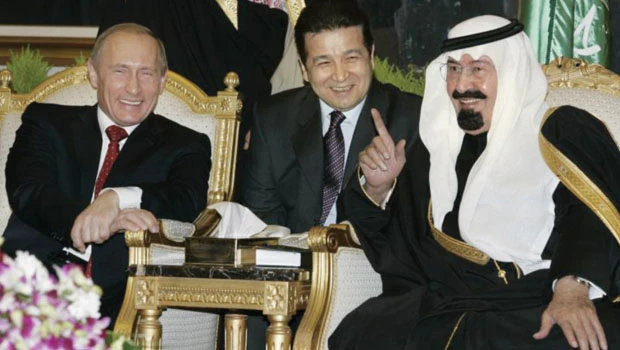
- With joint synergies, Riyadh and Moscow can play a greater role in global economy
Russia has been making strenuous efforts to regain its historical position in the Middle East after the collapse of the Soviet Union. This has become especially obvious in recent years after the election of Vladimir Putin and later Dimitri Medvedev to the presidency. Saudi Arabia turned out to be one of the new partners, with whom the new Russia ought to build the relations from scratch.
In September 2010, the 20th anniversary of diplomatic relations’ restoration between the Russian Federation and the Kingdom of Saudi Arabia will be commemorated. The alignment of business ties between the two countries took a fairly long period of time — about 15 years. Viable trade and economic exchanges between Russia and the Kingdom became apparent in 2004-2005 after the historic visit of Custodian of the Two Holy Mosques King Abdullah (crown prince at that time) to Russia in 2003.
Before that the volume of bilateral trade balanced at annual level of $100-150 million. The bilateral trade started to gain a stable momentum only in the second half of the first decade of the new millennium, when it grew at an average of 25 percent per annum.
According to Saudi Arabian Monetary Agency (SAMA), for the first time the turnover passed one billion mark in 2008, climbing to almost $1.1 billion. The same year, Russia moved to 24th from 33rd place for imports, and from 107th to 82nd for export among the Kingdom’s trade partners.
The structure of the Russian-Saudi trade is seriously unbalanced — virtually the entire trade accounts for Russian exports. The main trading items of Russian exports in 2008 were raw and low value-added products — barley, timber, steel bars and fittings and paper, which accounts for 75 percent of the total turnover. Approximately 15 percent of Russian exports goes for pipes, machinery and equipment, and only 10 percent for consumer goods. Saudi Arabia exports to Russia some petrochemical products, aromatic oils and sanitary ware.
The Russian-Saudi investment cooperation in recent years was also not moving at a desirable pace. Since 2004, the only major Russian companies operating in Saudi market are Lukoil (through JV Luksar with Saudi Aramco) — exploration for gas in Rub Al-Khali — and Stroytransgaz for construction of pipelines, conduits, oil and gas oilfields maintenance. Little or none has been heard of Saudi investments in Russia until recently.
Some substantial changes in the Russian-Saudi trade and economic relations became visible only in 2009-2010, after the first-ever visit of the Russian President Putin to Riyadh in 2007. The agreements reached in the course of this visit, as well as the global crisis that followed afterward, stimulated many Russian companies to search for new markets and shift their attention to Saudi Arabia, which had weathered the crisis considerably following its prudent policies.
Today the most active in the Kingdom’s market are medium-sized Russian companies. Over the year about 10 joint ventures with Russian participation were set up in Saudi Arabia and several Russian corporations registered its subsidiaries.
These are mostly construction and servicing companies, endeavoring to capitalize on large-scale infrastructure projects in the Kingdom. Some joint Russian-Saudi projects were initiated in third countries. Its most remarkable distinction is the merger of Russian technologies with Saudi capital. Many Russian technology-focused companies started working in the Kingdom through Saudi dealers and distributors, such as Kaspersky Lab — antivirus software, Suprotec — nanotech lubricants. Several Russian companies are currently prequalified by Saudi Aramco, Saline Water Conversion Corp., Saudi Electricity Company, etc., and are about to start operations soon in the pivotal areas for the Saudi economy, like rehabilitation of oil wells, turnkey telecom projects of traffic monitoring and control, construction of water and power-generating facilities.
With both governments’ participation, and due to the established business support infrastructure (Russian-Saudi Business Council, Russian-Saudi Intergovernmental Commission, regular exhibitions in both countries) and already elaborate legal foundation, the Russian-Saudi business alliance can rise to a new level in the coming years.
The main obstacle hampering the increase of the mutual trade and investment volumes is the structural and typological similarity of our economies — both states are major global oil powers and their core competence lies precisely in the field of producing, processing and trade of hydrocarbons.
However, this similarity to a great extent ensures the uniform nature of the challenges both countries’ economies are facing. Both countries are currently on the route to significant modernization and creating knowledge-based economies. Therefore the best chances for deepening and expanding the Russian-Saudi cooperation lie in the priority sectors for both economies. Sharing each other’s competitive advantages should contribute to the enhancement of mutual competitiveness and will ultimately lead to a more diversified involvement of Russia and Saudi Arabia in the global system of specialization.
The synergy of dual economic and financial potentials with entrepreneurial initiative will allow our countries to overcome the commodity dependence and start playing greater deserved role in the global economy.