- KANDAHAR: President Hamid Karzai called Sunday on community leaders in Kandahar to support a NATO campaign to bolster security in this Taleban stronghold, urging people to work with his government to “bring dignity back.”
NATO has already begun an operation to ramp up security in Kandahar, and the campaign is expected to accelerate in the coming months. Many of the estimated half-million Kandahar residents are skeptical of the operation, fearing it will lead to more bloodshed.
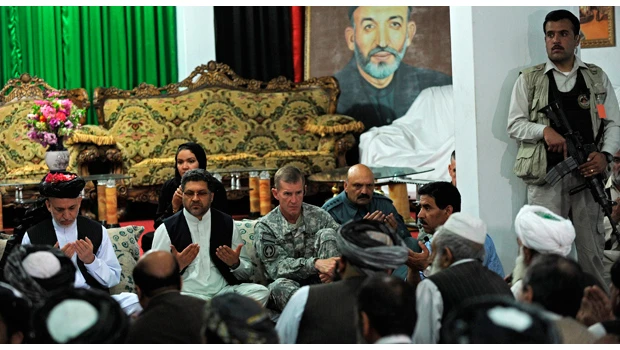
During a meeting in Kandahar city, several hundred people including tribal chiefs and religious leaders cheered as Karzai denounced corruption among police and local power-brokers.
He pounded the podium as he said corruption was undermining security as his government and its international partners struggle to turn back a resurgent Taleban.
Kandahar Mayor Ghulam Haider Hamidi said he thought as many as 90 percent of those in the room backed the security campaign but some were loyal to corrupt figures and the insurgents.
“Please give me your hand to bring dignity back,” Karzai said. He appealed again to the Taleban to lay down their weapons and reconcile with the US-backed government.
“Step by step we can go forward,” he said. “Let’s cooperate. Let’s coordinate.”
It was only Karzai’s second visit in recent years to Kandahar, the biggest city in the south and the spiritual birthplace of the Taleban.
US commanders believe control of Kandahar is the key to wresting the ethnic Pashtun south away from the Taleban, who have exploited public discontent with the central government to win broad support in the strategic region.
Insurgents have responded to NATO plans with a rash of attacks against those who support the government and its international partners. So far this month, at least 39 international troops have been killed in Afghanistan, including 27 Americans.
Six Afghan policemen and three NATO service members died Saturday in separate roadside bomb blasts. In addition, 39 insurgents were killed Saturday in two operations — one in Kandahar province and the other in Uruzgan province, the Interior Ministry said in a statement.
Top US and NATO commander Gen. Stanley McChrystal, who accompanied Karzai, and other officials have taken pains to avoid describing the Kandahar operation as a military offensive, a term that has made the residents wary about what was to come.
Presidential spokesman Waheed Omar said Karzai would call the campaign a “process of stabilization” to bring better governance, services and new development to the area.
Karzai’s influential half brother, Ahmad Wali Karzai, considered among Kandahar’s most powerful figures, said the favorable response from those at the meeting amounted to a green light for the security operation.
“The military operation is always a concern,” he said.
“The way the president described the military operation, there will no longer be a concern from the people.” The Afghan official in charge of local governments, Ghulam Jilani Popal, said the audience generally supported Karzai but some skepticism remained.
“In Afghanistan, people first see and then believe,” Popal said.
During his remarks, Karzai sought to address issues often raised by Kandahar community leaders — notably corruption that has driven many southern Pashtuns into Taleban ranks.
As the representatives sat cross-legged on a large red carpet, Karzai spoke about this month’s national conference, or peace jirga, in Kabul, saying it showed the Afghan people were united in their desire for peace.
Addressing the Taleban, Karzai said “please respect this call from the people of Afghanistan.” Karzai said people detained by the US and Afghan government for suspected insurgent links should be freed unless there were compelling evidence against them. “God willing in the coming weeks ... they will be released,” he said.
NATO officials had hoped that Karzai, who was born near Kandahar, would use his influence to encourage support for the security operation here. His visit was seen as a major step toward forging links between disaffected southerners and the central government in Kabul.
“This process of reaching out to Kandahar can only be led by the president,” said Tony White, spokesman for the chief NATO civilian official. “It can’t be led by us. It’s important for him to address the senior leadership — tribal and religious — and show his support for the effort.” White said Kandahar was isolated and disconnected from Kabul.
“Karzai can’t get it back into the fold without (the local leaders),” White said. “We anticipate that he will reassure them that there’s no military offensive planned.” As part of the effort to accelerate a political solution to the war, the United Nations announced that a UN
committee is reviewing whether certain people could be removed from a blacklist that freezes assets and limits travel of key Taleban and Al-Qaeda figures. That was a recommendation of this month’s peace jirga.
A committee is expected to complete its review at the end of the month and give its recommendations to the UN
Security Council, which will make the final decision on whether to remove any names off the list. The US, Britain and France, who maintain troops here, wield veto power on the council and would have to agree to changes on the list.