
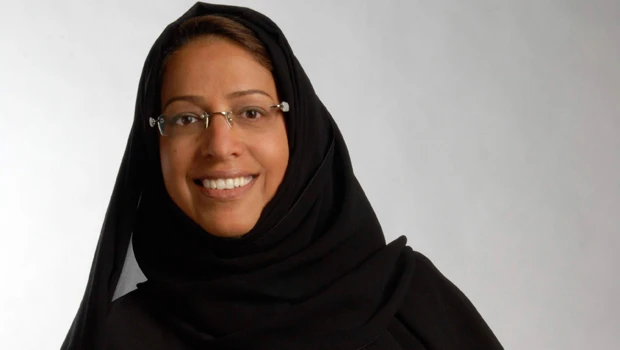
- Well-known businesswoman Nora Al-Shehail has earned recognition through her hard work as president of the Businesswomen’s Forum of the Eastern Province.
She has helped many young Saudi women take the steps to become successful entrepreneurs, but her true passion is working with common folk to help them realize how special they truly are and how much they can accomplish.
This starts with self-awareness, and the Cambridge-educated Al-Shehail has launched a company called Erada to help people break the shackles of self-doubt and learn they have what it takes to realize their dreams.
“Each one of us has a dream in life,” Al-Shehail told Arab News. “One has to be positive, and one has to have the desire to help others.”
She doesn’t like the term self help, preferring the concept of self-awareness instead.
“Nothing in the self is missing,” Al-Shehail said. “We are the creation of God, and God has endowed us with intelligence and beauty. We are complete. Alhamdulillah. When you say self-help it means you are handicapped when you are not. I call it self-awareness. When people are unaware about themselves … that is when there is a problem. My intention is to make people aware of their inner beauty. Erada, which means willpower in Arabic, believes in empowering people mentally. We train them to be better people. People are already good — we just want to make them aware of their inherent talent.”
One of the greatest enemies people of the Arab world have is complacency, she said.
“Most people here in this region are conditioned to accept the status quo,” she said. “That is very damaging. Our company focuses on two things: The will to let go and the power to accept.”
She says she realized the need for Erada — the first of its kind in Saudi Arabia — after having worked intensively in the field to earn her degree in life coaching and psychology. “For example, I taught people how to analyze their thoughts — how to investigate them. You take all the trouble to investigate a car before you buy one. You check its make, prices and features, but you never investigate your thoughts.”
She said many people are weighed down by excess baggage they have accepted as fact without challenging the ideas.
“If you had some thoughts when you were 9 they are still there when you are 29 because you have not analyzed them. Somebody came to me and said ‘I am worried because I don’t look good.’ I told her ‘You look good. You are OK, but because you have not analyzed those thoughts you are having a problem. You have left those negative thoughts unattended, and that is why it is affecting your personality.’”
Al-Shehail’s Erada plans to offer training to companies, families and individuals; to bring in international speakers who will discuss issues related to self-awareness; and to translate relevant publications into Arabic that reflect the school’s philosophy — the will to let go and the power to accept.
“The courses and the training material will be available in both English and Arabic; however, the people I intend to reach are those who are not very comfortable in English,” she said. “When we get foreign speakers we will translate their speeches in Arabic for the benefit of our clients.”
Although Erada was formally registered only recently she said she has been developing the idea and process for some time.
“I started this company in 2005,” Al-Shehail told Arab News. “That was the time when I started working with different consulting firms and businesses doing training and life coaching for executive management. Then we had life coaching for families and individuals. Every year we have huge summer camps where we train trainers — teach people how to communicate effectively with others. We operate in Saudi Arabia, Bahrain, Kuwait, Lebanon, Syria and Egypt — throughout the Middle East.”
The youngest of six children, Al-Shehail’s father died when she was 9. The independence she learned early on is essentially the same independence people need to progress both in life and their own self-awareness.
“At age 11, I had to live with a British family in London for four months,” Al-Shehail said. “I had to learn to be on my own. There was no mom or dad there to indulge me. That helped me develop my personality. Those same values are instilled in my children — to be independent and to be helpful to others.”