
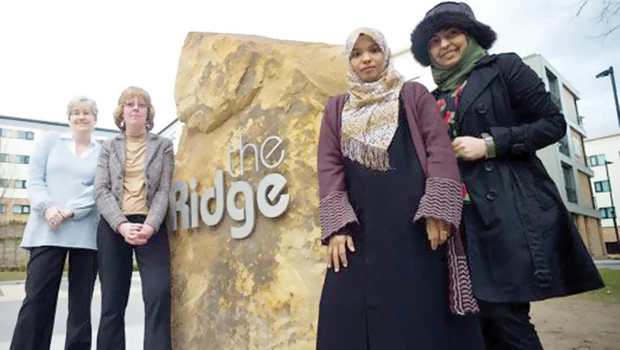
- Budding Saudi businesswomen are traveling around the globe to improve their education before starting their own business.
They come back to Saudi Arabia harboring hopes and ambitions to apply what they learned abroad.
The hands-on learning experience is what students often look for when they take the decision to pursue their education abroad. They want to utilize what they were taught in class.
They, however, question if they will find a suitable environment within the business market welcoming them back.
“I wanted a program that focused on the application of business theories and concepts in real life. I am now studying how to turn ideas into commercial practice,” says 27-year-old Alaa Wafa, who is doing a business master’s degree specializing in entrepreneurship and technology at the University of Waterloo in Canada.
She is already working on her group practicum project or “business concept”, which will contribute toward launching a new business or product.
She thinks that most of the theories she is learning are relevant to the Saudi business market, but there are also others that would be impossible to implement.
“What I study here overemphasizes the importance of market research before developing any idea. This will be very hard to apply back home due to the unavailability and inaccuracy of Saudi statistics,” said Wafa.
Wafa is aiming to start her own early education business, as well as an enterprise trading in smart phone applications in the future.
She believes that obtaining funding will be the first obstacle since financing options are limited.
“Although there are some government agencies and private organizations that provide funds to support startups, they are not enough and their funding is between SR50,000 and SR200,000. This is not enough in most cases unless you want to start a business as small as a barbershop or mini convenience store for instance,” she said.
Wafa is learning how to recognize and evaluate new opportunities in the market and come up with creative innovative ideas to take advantage of them.
“I’m in the evaluation stage of my business concept now. I’m working on the market research and the business plan that will help me put together the budgeting plan. After that I will start looking for a source of funding when I’m back in Jeddah,” she said.
Amal Alabbasi, 26, is doing her master’s in international business in the US state of Texas. Her husband is a postgraduate student as well.
“We need freedom in Saudi Arabia. By freedom I mean the ability to get our business done without being forced to be dependent on men. Some of our customs are unfortunately still holding us back and controlling the business environment,” said Alabbasi, who is studying at Sam Houston State University.
Sarah Al-Hamed, 21, chose to study accounting for management at Aston University in the English city of Birmingham.
She said in order for a woman to start a business in Saudi Arabia, she needs to have a strong personality and people who can support her, like her family. According to her, obtaining a legal male guardian is among the obstacles a woman might face.
What Al-Hamed and possibly other Saudi women do not know is that a legal guardian is no longer a condition for a woman to start a business.
However, she needs a male manager if her business is set in a mixed environment, says Basma Al-Omair, executive director of the Jeddah Chamber of Commerce and Industry’s Khadija Bint Khuwailid Center.
“We are still lobbying to get that condition removed with the Ministry of Commerce and Industry. As far as everything else is concerned, we’ve been able to change things and now women can trade in real estate, construction, contracting and public services, which used to be forbidden for women.”
Al-Hamed believes Saudi Arabia is now more ready than ever to welcome back students who are educated abroad.
“Employers are adjusting to the idea that some women study abroad and prefer to employ them for their better knowledge and to give the business a variety of ideas and points of view,” she said.
Al-Hamed may be luckier than other students. She secured her job before she left the Kingdom since she is on a scholarship from Saudi Aramco.
“I have a job waiting for me in the control department in the company,” she said.
Sarah Aburoayan, 25, is also doing her master’s at Aston University, whose business program is ranked first in the UK and fifth in the world.
“What I’m studying now might need some time to develop back home and it may only be relevant to larger organizations at the moment,” said Aburoayan, who is studying work psychology and business studies.
She is trained to do psychometric tests and promote a healthy working environment for employees and how to motivate them.
She is looking to become a consultant in occupational psychology, a field that is still new to the Saudi job market but which she believes is helpful at a time when unemployment is a major problem in Saudi society.
She says for a businesswoman to succeed in Saudi Arabia, she has to be strong, determined and patient.
“It could be hard to prove herself among people who think that her place is at home bringing up children and being dependent on males to sort out legal matters. As for me, it could be challenging to promote what I have to offer to organizations,” Aburoayan said.
Basma Al-Omair advises Saudi students studying business abroad to realize that local laws, policies and procedures are not compatible with what they have studied abroad.
“I also encourage students to take the opportunity and do internships while they are studying in international companies to experience how business is conducted,” she said.