
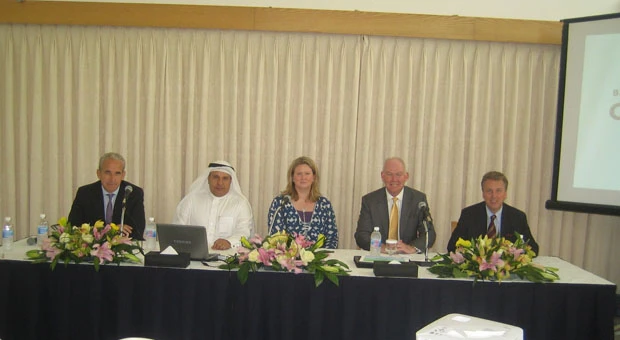
- JEDDAH: Despite the impact of the world economic crisis, the British Offset Office, which manages the Saudi British Economic Offset Program on behalf of the UK government, said its involvement across Saudi Arabia continued apace.
- “The Kingdom’s economic scenario is positive and the prospects for new joint ventures and partnerships bright,” a senior executive of British Offset told a meeting of businessmen at the British Consulate General on Monday.
The meeting, convened by British Consul General Kate Rudd, outlined the range of assistance British Offset could offer in identifying new projects and opportunities, and in taking them forward under the Offset Program. “We can help bring together potential partners and provide detailed and confidential advice of financing and other incentives under the program,” Tony Smith, senior executive at the London-based British Offset Office, Ministry of Defense, said in his presentation.
Smith emphasized that British Offset was pursuing an economic program across the Kingdom with certain aims and objectives — reduce dependence on oil, devolution of Saudi industrial base, import substitution by encouraging local manufacturing, acquire foreign technology, provide investment opportunities for private capital, create jobs for young Saudis, encourage manufacturing or service sector, and facilitate joint venture or licensing agreements. “Above all, we help identify project opportunities and advice on suitable partners,” he said.
Among the target sectors for possible joint ventures are petrochemicals, particularly downstream projects, pharmaceutical and medical, power and utilities equipment, telecommunication and IT equipment, agrotech and food processing, general engineering, Smith said and reviewed the assistance enabled by British Offset in recent times. These include $145 million sugar refining and $26 million petrochemical plants in Jeddah and some other projects in Riyadh, Yanbu and the Eastern Province. Vocational training is among the projects in Riyadh, and Eastern Province projects include a $38 million waste oil recycling plant. He clarified that equity loans were available only for manufacturing projects. “We are also looking for more vocational training programs than those for higher education,” Smith said.
The Economic Offset Program was established to help diversify the Kingdom’s economy and broaden its industrial base through the creation of commercially viable and profitable joint venture projects, he said, adding that new joint venture companies create much-needed jobs for Saudi nationals, mobilize private capital and help reduce the Kingdom’s reliance on imported goods.
Smith said British Offset was also able to offer the foreign partner a loan for up to 50 percent of their equity, up to a maximum of $10 million, in a new joint venture project. Other practical benefits that British Offset could bring to a project include free investment bank advice and in certain instances financial assistance with pre-project feasibility studies.
He added that British Offset had many years experience of setting up joint ventures in Saudi Arabia. Its links with the key decision makers in the Kingdom can bring early resolution of problems standing in the way of joint venture agreements.
In particular, its close working relationship with the Saudi Arabian General Investment Authority, the official agency responsible for granting licenses and approvals in the Kingdom, can significantly simplify and speed up the bureaucratic process.
All joint ventures in Saudi Arabia require government approval. Joint ventures established under the Saudi British Economic Offset Program involve no additional bureaucracy.