
- Superfruits are many and you may be wondering where do they stop.
- The list may not end because as I finish writing about Paul Gross’ twenty superfruits (mango, fig, orange, strawberry, goji, red grape, cranberry, kiwifruit, papaya, blueberry, sweet and sour cherries, red raspberry, seaberry (seabuckthorn), guava, blackberry, black currant, date, pomegranate, acai (assai), and plum), I suspect new ones will emerge.
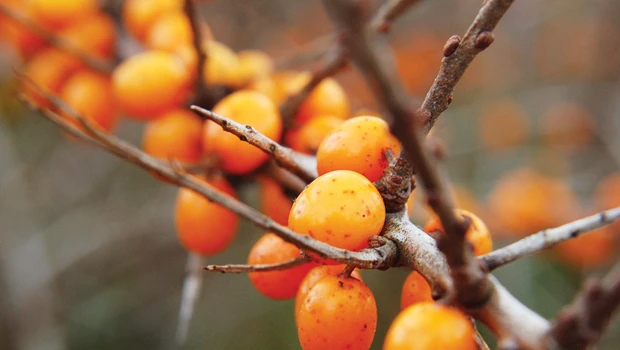
Today’s highlighted superfruit is the seaberry. Little has been written and not much is heard about this berry outside Northern Europe, Russia, and Asia. The seaberry, or seabuckthorn (Hippophae rhamnoides), is an orange-yellow berry that grows on shrubs that grows in deserts and near the sea in Russia, China, and India hence the name seabuckthorn. The hardy shrub grows wild and in cultivation, and it is thorny thus making it tough to harvest.
Seaberries have a high concentration of nutrients. The pulp comes with a strong citrus flavor and is rich in oil and organic acids, which do not marry very well. The taste is therefore not so appealing. Nonetheless, in the above countries where it is known, the berry is appreciated for its high nutritional value. It is made in juices, cordials, infusions and jams. It is also used as dessert garnishes and to flavor food and beverages. In fact, the nutrient-dense seaberry has a good potential to be used as a dietary supplement for malnutrition and in famine stricken areas.
The seabuckthorn’s exceptional nutritional status comes from its content of the antioxidant vitamins: A, C and E. Vitamin A comes from the orange-yellow carotenoid of the berry and Vitamins C and E are found in the oil of the pulp and seeds. These vitamins are an unusual combination in plant foods, giving the fruit an outstanding status, even as a single berry. For such a small fruit, its mineral content of calcium, iron, potassium, manganese and magnesium is quite impressive.
The seabuckthorn provides yet another interesting combination of prebiotic (soluble) fiber, phytosterols, vitamin E, and omega-3-6 and-7 fatty acids coming from its alpha-linolenic acid, which appears to be a welcome ingredient for cardiovascular health. On the down side, the pulp contains unwelcomed saturated fatty acids in the form of palmitic acid. Though not recommended for the heart, the fat is valuable topically to skin health, making it attractive for the beauty care industry for manufacturing body creams, lotions, soaps, balms and hair products.
Apart from vitamin A, the precursor beta-carotene in the orange-yellow skin of the berry, the fruit also holds high amounts of phenols. Because its phytocompounds, carotenoids and polyphenols are bioactive and easily bioavailable, the berry is ideal for different organ and cellular functions.
A Japanese experiment on rats which were fed seaberry pulp powder, showed that serious cardiovascular problems could respond positively to its compounds, making it promising for humans as well. This indicates that its saturated fat is not as harmful as suspected.
Finnish, Chinese and Russian medical researches are actively working to see the possibility of employing the berry’s compounds in treating inflammation, skin injuries, eyesight degeneration, blood clotting, bacterial and fungal infections and even cancer.
Romanian scientists found that bioactive chemicals in seabuckthorn berries enhance cancer therapy, especially when fresh fruits, herbs, honey and grape seed extract are included in the diet along with the superfruit. However, regulatory agencies in the West such as the Food and Drug Administration (FDA) seem to be hesitant in supporting the above medical research claims.
Unlike in the United States, seaberries are more easily found in Europe, India, China and Japan. Even though the fresh berries may not appeal to the layman’s palate due to their unusual flavor, which is rather oily, musky and sour, they are common garnishing desserts in European restaurants. The berries are included in beverages, nutritional bars, tea, sauces and marmalades. They are not as unpleasant as they sound; in fact, I enjoyed their crunchy texture and zesty taste. Next time I am in Europe, I will buy a few small boxes so that I can take my eight-ounce juice helping. Why not? I look forward to their nutrient-packed benefits. What is good for my health is welcome by me!