
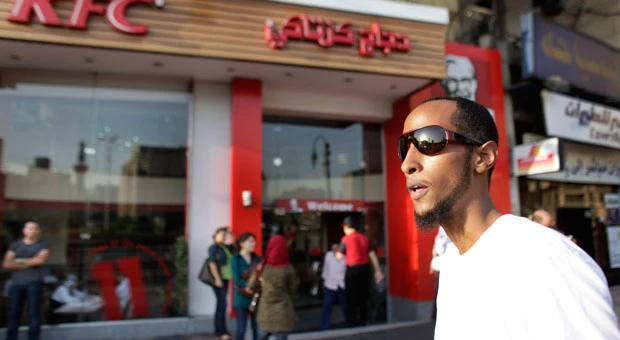
- CAIRO: A Virginia man, stuck in Egypt for the last six weeks, living in a cheap hotel and surviving on fast food, said Wednesday his name was placed on a US no-fly list because of a trip to Yemen.
Yahya Wehelie, 26, who was born in Fairfax, Virginia, to Somali parents was returning with his brother Yusuf from 18 months studying in Yemen, when Egyptian authorities stopped him from boarding his flight to New York saying the FBI wanted to speak with him.
Wehelie said he was then told by FBI agents in Egypt his name was on a no-fly list because of people he met in Yemen and he now cannot aboard a US airline or enter American airspace. His passport was also canceled and new one issued only for travel to the United States, which expires on Sept. 12. He does not have Somali citizenship.
US authorities have put Americans studying in Yemen under heavy scrutiny after a number of failed terrorist attacks were linked back to Al-Qaeda's branch in Yemen.
FBI spokesman Paul Bresson said the bureau does not comment on whether a particular person is on a watch list.
While Bresson did not discuss the FBI's interest in Wehelie, he did note several recent high-profile terror plots, including an attempted car bombing and a failed Christmas Day jetliner bombing, as reminders of the need to remain vigilant.
Egyptian authorities confirmed there is a Somali-American stranded in Cairo waiting for his name to be lifted from a no-fly list.
Wehelie, however, said he had no dealings with the terrorist organization while in Yemen and does not even see himself as a particularly observant Muslim.
"It's amazing how the US government can do something like this," he told The Associated Press Wednesday from his ramshackle hotel in downtown Cairo.
"I'm cool with all their fighting terrorism and all that, I'm cool with that, I like that, more power to them," he said in American accented English, wearing baggy basketball shorts and a long white T-shirt.
"My home is America and I don't know why I can't go back there," he said, adding that he even suggested to the FBI to "put me in like ConAir or something ... in an airplane with a bunch of US marshals or whatever in handcuffs just get me back home."
While in Yemen, Wehelie studied information technology at the Lebanese International University in the capital and also married a Somali woman whose family had close ties to his own. She remains in Yemen.
Wehelie said the US Embassy has not given him any indication of how he can get off the no-fly list, but for now it is paying the $16 a night for his hotel and gives him coupons to eat at US fast food chains.
In a news conference held in Washington by a Muslim civil rights group, his mother Shamsa Noor said she sent her sons to Yemen to learn Arabic and get some direction in their lives and now she feels guilty for that decision.
"It is very frustrating. I feel so guilty because I'm the one who sent them there," Noor said.
Officials at the Council on American-Islamic Relations, which sponsored Wednesday's news conference, said they are aware of at least two other cases American citizens who are Muslims are similarly denied return to the United states.
CAIR's executive director, Nihad Awad, said the organization understands the need to question travelers and the need to protect national security. But he said the no-fly list is being used as a weapon to punish American Muslims without providing due process.
"We are very concerned that this apparent targeting of American Muslims sends a very wrong message to American Muslims that they are second-class citizens," Awad said.