
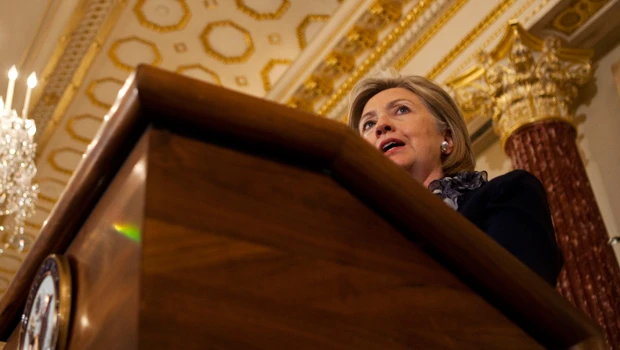
- WASHINGTON: Secretary of State Hillary Rodham Clinton, urging Senate approval of a new US-Russia nuclear arms treaty, on Thursday sought to reassure lawmakers the pact will not constrain US missile defenses.
Clinton noted that the Russian government has stated that it reserves the right to withdraw from the new START treaty if it feels threatened by an expansion of American defenses against ballistic missiles.
"But that is not an agreed upon view, that is not in the treaty," Clinton said. "It's the equivalent of a press release and we are not in any way bound by it." Clinton told the Senate Armed Services Committee that the US has issued its own statement about missile defenses, "making clear that the United States intends, and in fact is continuing, to improve and deploy effective missile defense systems." Some Republican members of Congress have questioned whether the treaty imposes limits on US missile defenses.
Clinton testified on the treaty alongside Defense Secretary Robert Gates, Energy Secretary David Chu and Adm.
Mike Mullen, chairman of the Joint Chiefs of Staff. All four urged the Senate to ratify the pact as soon as possible.
The treaty was signed by President Barack Obama and Russian President Dmitry Medvedev in April.
It would put a ceiling of 1,550 on the number of each country's deployed nuclear warheads, down from the current limit of 2,200. The pact replaces the 1991 Strategic Arms Reduction Treaty, or START, which expired in December. To be ratified, the treaty needs 67 votes in the 100-member Senate. The Russian parliament has not yet acted on it.
Gates told the committee that the administration is moving ahead with its missile defense plans, and that it will invest far more in modernizing the nuclear stockpile.