
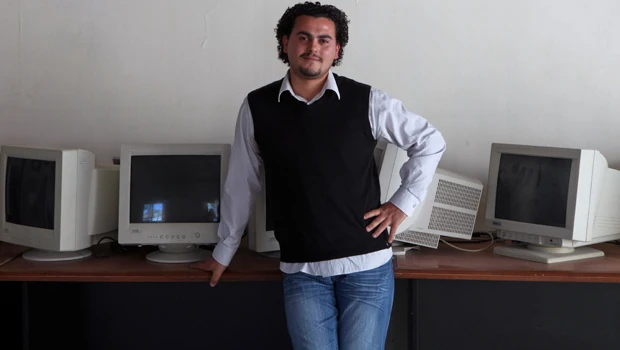
- NAZARETH, Israel: In the year since he graduated from Israel's top technical college, Samer Kablawi has sent out over 50 resumes to high-tech companies — and had one interview.
It's a predicament that may seem typical for young graduates in a world still emerging from recession. But Kablawi notes one discrepancy: While his fellow Arab classmates have struggled to find work, most of his Jewish classmates landed high-tech jobs months ago.
“I don't want to use the excuse that because I'm Arab, they're not taking me,” said Kablawi, 29, who is fluent in Hebrew, Arabic and English, and says he did better in school than many of his now-employed classmates. “But when you think about the numbers, it will hit you very hard.” It's a refrain long sounded by Arabs citizens of Israel, who argue they face widespread discrimination in the workplace. The Israeli government says it now wants to do something about it, with a $250 million initiative with local venture capitalists to boost the Arab sector.
Arab leaders, however, are skeptical, pointing to past promises that fell through and saying the money falls short of what's needed.
Decades of neglect and discrimination have fueled ever-worsening tensions, and the Arab sector is largely uncharted territory for Israeli lenders and employers.
In Nazareth's industrial zone — the main hub for enterprise in Israel's unofficial Arab capital — modest, roughly constructed buildings and cluttered storage yards stand in sharp contrast to the glittering corporate towers of Tel Aviv, or even the modern factories of Upper Nazareth, the Jewish development town next door.
Like most Arab towns in Israel, Nazareth's industry is mainly small businesses — meaning there are few chances for Arabs like Kablawi and his friends to find jobs in their fields.
There are early plans to help that change — a private investor has announced plans to build Nazareth's first-ever joint Arab- Jewish industrial park to give local workers easy access to the global high-tech scene. And the government's revitalization program envisions filling such workspaces through a $200 million investment in Nazareth and nine other Arab communities that's mostly directed toward helping companies create jobs.
But to Israeli Arabs, the funding plans are nothing to bank on.
“Any additional budget is welcomed, but it's still very far from the real needs,” said Ramiz Jaraisy, Nazareth's mayor. The real test, he said, “will be according to the implementation of the plan.” He and other Arab leaders point to past promises such as a 2000 pledge to invest about $1 billion in the Arab sector that failed to materialize.
Arabs citizens of Israel make up one-fifth of the country's population and many have a complex relationship with the Jewish state.
While Israeli law gives them the same rights as Jewish Israelis, in practice, they are an underclass, receiving less-than-equal services and treatment — which fans the flames of mutual distrust with the Jews.
Israel's 1.3 million Arabs account for only about 8 percent of economic activity, according to Israeli government statistics. Arabs lag far behind the Jewish population in income and employment levels, while poverty rates are much higher.
According to a recent parliamentary study, Arabs hold only 6 percent of public sector jobs in Israel — and less than 2 percent of the positions in most of Israel's government ministries and parliament.
In the private sector, Arab entrepreneurs have traditionally struggled to get loans from Israeli banks due to discrimination or property laws that favor Jewish ownership, said Ayman Saif, director of the government's economic development authority for minorities.
In recent years, government funding for Arab Israeli towns was reduced, according to the Mossawa Center, an advocacy group for Arab Israelis. Many Arab leaders wonder whether the money they are being promised under the new initiative isn't simply a trade for funds lost elsewhere.
“We have no reason to believe that everything is going to be better,” said Mohammed Darawshe, co-director of the Abraham Fund, a nonprofit group that promotes coexistence projects.