
- Last week, personal fitness trainer, Eric Garcia, developed a four-week cardio and weight training program to help you lose weight and tone up.
- In part two of this special three-part summer series on getting the body you want, you will be provided with the second part of the fitness program as well as some diet tips from a certified dietitian that will help you lose weight and keep it off.
Before getting started, however, it is important to note that it is not possible to reduce body fat and lose weight if you don’t eat the right foods and the right amounts. In order to lose weight, you need to burn more calories than you consume so that your body doesn’t store the extra energy as fat. That is why exercise and diet should go hand in hand.
Also, you have to realize that losing weight is not a one-time thing, but rather a life-long change. As a result, you should not turn to quick and extreme diets that promise fast results since they do not work in the long run and can be dangerous to your health.
“The diets that make you lose weight very fast are not a good sign,” says Lea Matar, a dietitian based in Montreal, Canada. “These drastic measures make you lose water and muscle rather than the unwanted fat. Even more, they will make your metabolism slow down. Consequently, when you go back to eating normally again, you will gain weight and be caught in a vicious cycle.”
In order to successfully keep the weight off, she recommends losing the weight slowly and patiently.
Here are some healthy eating tips from Matar that will aid you with your weight loss:
Drink at least eight cups of water a day as it is vital in keeping your hormones working properly and promotes calorie burning and fat loss.
Foods high in fat, salt and sugar such as: candy, ice cream, chocolate, chips, soft drinks, cold-cuts, chips, canned soups, condiments, fried foods, butter and meat with visible fat.
Fruits and vegetables, legumes and whole grains as they are excellent sources of vitamins, minerals, protein and fiber.
Replace refined carbohydrates like white rice, bread and flour and with tasty whole grain versions as they have more nutritional benefits. Furthermore, their fiber content makes them more filling and more slowly absorbed in the body.
“I recommend the Mediterranean diet since it emphasizes plant-based foods — vegetables, fruits, legumes and whole grains — as well as unsaturated fats from olive oil, which is better for the heart,” says Matar.
The Mediterranean diet is modeled after the eating patterns of some Mediterranean regions in the early 1960s including: Crete, other parts of Greece and Southern Italy. The reason these dietary patterns were singled out is due to the fact that these people had some of the highest life expectancies in the world as well as the lowest rates of coronary heart diseases. Moderation is key in this diet, which is why nothing is off limits. Along with physical activity playing a large role in people’s daily lives, this style of eating is based on really savoring what you eat with family and friends in a slow manner.
Follow the Mediterranean diet pyramid to know how much emphasis to place on each food group. The bottom part of the pyramid is what you should be eating most of and the top part is what you should be eating less of.
According to Matar, a typical daily menu should include three meals a day composed of protein, vegetables and complex carbohydrates.
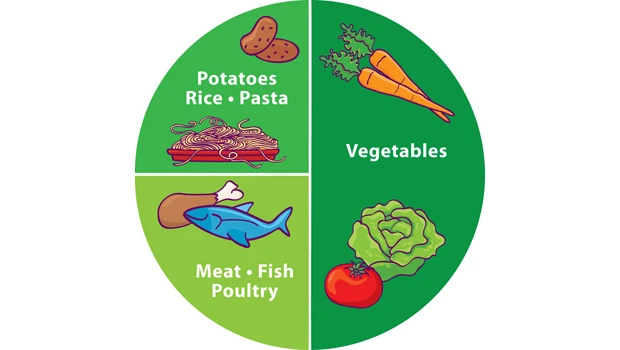
To better visualize how much to put on your plate, mentally divide your plate into two sections. Half of your plate should be salad or vegetables and the remaining half: 1/4 protein (size and thickness of your palm) and 1/4 complex carbohydrate (a fist size).
Examples of complex carbohydrates: potatoes, pasta and whole grains and cereals (bread, rice, wheat, oats, bulgur and cousous, etc).
Examples of protein sources: lean meats (chicken, fish, tofu, beef, etc), egg whites, legumes (beans, chickpeas, lentils, etc) and low-fat dairy (milk, yogurt and cheese). Instead of deep-frying meats or serving them with gravy or other high fat sauces, Matar recommends baking, broiling, poaching or roasting meats and allowing the fat to drip off.
“This plate division is filling and helps in losing weight. If you’re hungry between meals, snack on fruits and low-fat dairy products,” says Matar.