
- It was not exactly a ‘Road to Trepidation.’ For many had waxed eloquent about the roads in the Kingdom and the first class travel to and from cities.
Most take the bus to travel to the holy cities as a mode of transport not only on the physical plane, but also on the spiritual plane as they travel to Makkah and Madinah from various parts of the Kingdom as well as from other Gulf cities.
It was some of my friends’ experiences, as well as the need to try firsthand an inter-city bus ride that got me to choose this mode of travel from Riyadh to Jeddah. It was an eventful journey, as all journeys are, and well worth the experience.
When I first voiced my intentions, my friends in Riyadh looked at me as if the Riyadh heat had finally got to me. For during the four-day stay in the capital, I was given a taste of the dry heat that sears the city.
For my friends, road trips in the Kingdom are either made in groups in cars or SUVs over short distances. For them the preferable and fastest mode of travel is overhead by planes.
All the more so with the advent of budget airlines that has increased the frequency of air travel, is light on the pocket, while also putting a type of roadblock on those taking the bus.
That’s why, despite having a ticket to travel (by plane), I chose the alternative route. Instead of a one and a half hour flight, I had to endure a 10-hour trip on a SAPTCO bus, all because of my own flight of fancy.
Most people taking the bus are those who need to travel immediately or those whose pockets do not extend to buying an air ticket. Some do it for the scenery — enjoy the desert and the topography, which even at night exudes its own charm.
Travel, they say, widens the horizon. And bus travel, in its own way, does. You come across a wide cross-section of people you generally would not meet on other forms of travel. Invariably many of them are warm and friendly — maybe because they have time to kill both before and during the journey.
In many ways the start of the road trip from Riyadh mirrors that of air travel. At least, mine did, from the capital to the bride of Red Sea. The bus terminus is akin to an airport, with the processes and procedures being more or less similar.
The Riyadh bus station is plush and has been designed to look like a mini-airport. Ticket counters abound and every route has its designated counters.
Buying tickets now has become stricter with your personal identification being a must. Earlier, others could buy tickets with copies of their own identity cards, but nowadays it is necessary for the passenger’s identification to be shown to purchase a ticket. The identification number is then filled into the ticket.
These precautionary measures were enforced to the full at every counter, as a cursory visit to three different counters showed. What was more revealing was that all the three ticket vendors were bilingual and offered directions and answered queries in English when told that I did not speak Arabic.
As is the case in an airport, generally people come well in advance before the bus departs and wait in the lounge — there are separate lounges for men and women. Most people travel with limited baggage, but those with heavy loads can check in their baggage at the luggage counter, similar to those in airports.
The checked-in luggage is then transported to the respective buses and put in the main luggage hold. But most travelers carry small bags that are carried to the bus by them and put in the forward hold, while carry-on luggage are put inside, on the bus’s top racks.
My bus was timed to leave at 6.00 p.m. and exactly at 5.30 p.m. the announcement was made for people to board. There are display monitors highlighting the status of the different routes and buses, the gate number from which to board and the time the bus is to depart — both in Arabic and English. So for a first-time traveler or someone new to the city, it is all an easy ride.
One thing singles need to know is that the seating arrangements are precise with families and women seated in the front and on one side. There’s even a light highlighting the rows.
There are two drivers per bus and they take turns driving on the 10-hour journey. The drivers of our bus, No. 8730, were an Indonesian and a Syrian. The Indonesian, Omar, has been making this Jeddah-Riyadh-Jeddah run for the last 12 years and is very comfortable with it. The Syrian driver Essam too has been in for the long haul.
Both said that the work, though hard, has its rewards. In addition to the salary they draw, they increase their income with overtime pay. There are no off days for them, but after every 12 hours they get a big break before it is back to the driver’s seat for them.
The bus I journeyed in was to depart from Bay 10 and after my ticket was checked and I was cleared into the departure lounge, I waited along with other passengers.
Through the glass separation one could see the bustle going on outside. People were embarking on different buses while buses were slowly slipping into their respective bays while readying for the trips to their destinations.
At quarter to six, SAPTCO Bus No. 8730 turned into Bay 10 and came to a halt. Omar and Essam alighted from their seats and lifted the cover of the hold, on either side, revealing the cavernous stomach of the bus that would carry the passengers’ assorted baggage.
Regular travelers know the trick of bagging the best seats. After families (only two families made this trip) were given priority at the gate, the singles were made to stand in an orderly queue and then let in one by one.
I later realized, when I found a seat right at the rear end of the bus, the reason for the jostling in the line. The seats are on a first-come-first-served basis, and the best two seats are in the middle with more legroom.
Typically at Bay 10 (the origin of my journey), there were two security personnel at the gate. All passengers were asked to keep their tickets and identification (bataka or iqama) ready to be checked before boarding.
The two divided the work as the line was cleared quickly. One collected the carbon copy of the ticket, while the other checked the identification. Within ten minutes the bus was full and ready to roll.
If you are going to make this trip then it would be advisable to carry your own form of entertainment — a Walkman or iPod — to keep you company as the bus plows along the superb roads.
As the bus slowly made its way through the evening city traffic, the orange glow of the setting sun on the horizon meshed with the twinkle of the city lights providing a picturesque relief to the hustle and bustle of the Riyadh roads.
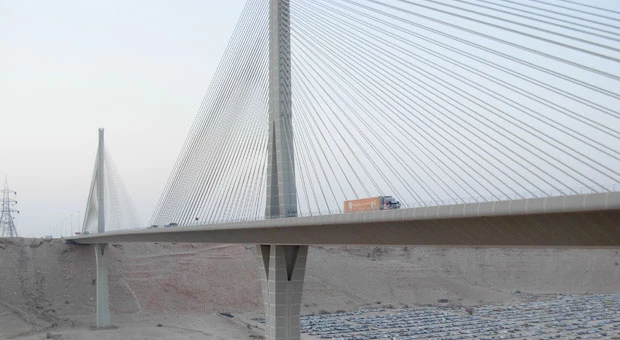
The sight through the tinted windows of the bus is all the more evocative when the bus passes through the city’s landmark — what is called the San Francisco Bridge because of its architectural similarity to the original bridge in the Bay area — before leaving the precincts of Riyadh.
The sun going down and the flicker and flash of the lights going up offer a seamless flow from light to darkness. As if on cue, the driver too turns off the lights (seven in number) in the central aisle with just the night lamp providing a shimmer of light inside the bus. The drawn curtain brings in the fading light of dusk as most of the passengers fall silent.
Watching the desert scenes flashing by could become a wee bit monotonous during this long ride, especially if you are traveling alone.
But with company the ride could take a different turn, as the two Sudanese seated next to me showed. They became traveling friends, talking about issues that ranged from the comfort of the seats to their nation’s health.
The buzz, as is generally the case at the start of the travel, was on as the impromptu groupings — mostly on the lines of nationalities and region — that began conversing. The intermittent sound of talk was the only sound over the steady hum of the air-conditioning with the gentle roar of the engines, interspersed with the grinding whine of the bus slowing down, providing the indication that the bus was steadily eating up the distance.
Many heads begin to nod and some fell into blissful sleep as the bus continued to swoosh through the steady gradient of nearly four kms that highlights the valleys of Riyadh. Pockets of hushed conversations underline the fact that not all have been hit by the Sandman.
My immediate neighbors, Ahmed Hassan and Mohammed Ahmed — both Sudanese — were deep in conversation for the majority of the early part of the journey. But as their chat became interspersed with silence, I took the opportunity to get a word in with them.
Hassan, an accountant in Riyadh, was enjoying his first ride in a bus to Jeddah. Though he had driven to Makkah with his friends in a car, his views on the trip so far was “enjoyable.” He was on his way to Khartoum for a month’s holiday and that fact also made for a good time in the bus.
Mohammad meanwhile had many miles to go. He had taken a bus from Khafji to Riyadh, waited eight hours in transit, and was doing the over 10 hours travel to Jeddah before going to the Jeddah port to catch a ship to Sudan’s oldest port Suakin.
The first question that sprang to mind was ‘How do you do it?’ Mohammed, who does this every six months to sustain his import-export business, said it’s OK, I get the pulse of the people during these trips. “But today, I’m tired. I’ve already gone 20 hours without sleep. Now I need to catch up.”
As Mohammed retired to sweet slumber, Hassan and I continued our banter intermittently with each of us swapping our life’s experiences. His tale mirrored that of nearly every expatriate working in the Kingdom. The money earned was a bounty for the family.
But the most bubbly characters were two young Saudis, who had just made the grade following interviews in Riyadh and were soon to join the workforce. Fahd Hassan Al-Bishi, a secondary student, was celebrating his entrance into the police. He was already contemplating the six-month training and his future in police colors.
Al-Bishi, a first-time traveler by bus, was just happy to be accepted. He was going home to a village near Taif to spread the good news. His more circumspect friend, Mohsin, too had made the cut. “I made it after a three-year wait. I am just happy that I have a job now,” he added.
Al-Bishi’s mood was infectious. His sudden breaking out into songs accompanied by clapping cut through the silence in the bus like an alarm clock’s blaring ring. Though Mohsin tried to curb Al-Bishi’s enthusiasm, a group of Egyptians woken up by the sudden tune too joined in as the bus briefly took on a picnic mood.
After a three-hour run, the bus turned toward a roadside rest house at Halband for a half hour break. Passengers, apart from stretching their legs and have their meals — a minimal fare of kapsa or broiled chicken on offer, made a beeline for the restrooms.
This is one area of the trip that is a veritable nightmare for all travelers. SAPTCO could well do with restrooms, manned with cleaners, in these pit stops as part of their service. If this facet of their service improved, then there could well be more people taking the bus.
Apart from the appalling sign that directed one to the restrooms, “Jents path Room”, the smell would force one to beat a hasty retreat. Some braved the smell, puddles and all to the bathroom, but after a glimpse of the horrors inside as the doors of the toilet opened, I beat it back quickly to the bus.
The break, however, was a good one as the wide maidan on which the buses halt provide space for smokers as well as the walkers. For a brief while, the area was bustling with people, with many watching the night traffic roll by as a cool breeze wafted around us.
As the bus prepared to move on, the drivers switched duties, and the second driver makes a head count before the journey restarted. The distance between stops — from Halband (around 9.30 p.m.) to Al-Moyit (around 1.00 a.m.) in Taif district — is covered in virtual silence, with the silence of the night broken by the occasional mobile ringtones.
Some of the passengers disembark at this point, while the rest get back into the bus to complete their journey. The ride now was slowly telling on all as people just slept through the remaining miles.
But as if an in-born alarm had gone off, people slowly came awake as the lights on the outskirts of Jeddah became visible. The speed of the bus slackened as it entered the city limits and as the bus slipped into its bay in the Jeddah stop in Balad, the mad scramble at the start of the journey was duplicated as passengers wanted to get off quickly and carry on to their homes or continue their journeys.
Officials in SAPTCO, Riyadh, said bus travel was growing in the Kingdom and they were in the process of expansion. They said, the buses they ran were all premium buses and were refurbished at their workshop in Riyadh.
They said that they ran 10 to 11 intra-city buses and were on call 24/7 in the event of a bus breakdown anywhere in the Kingdom. They also said a new Riyadh-Qassim route has been added and a premium Makkah-Madinah (VIP) run was also on the cards. The VIP buses would be having excellent packages.
But for all the expansion, SAPTCO has to consider setting up clean toilets on the routes. They could go the route of setting up SAPTCO stops for their buses and road travelers where it is a one-house stop for everything — food, fuel and clean toilets.
Except for the fact that the ten-hour ride was heavy on my bladder, the first-time experience was remarkable. Next time, at leisure, I would like to go in a group on this bus test drive to feel the difference. But hopefully by then, I hope the stench of the restrooms will have gone away.