- TORONTO: This is a different Toronto today.
- As one traveled to the Media Center Sunday morning, the difference was evident.
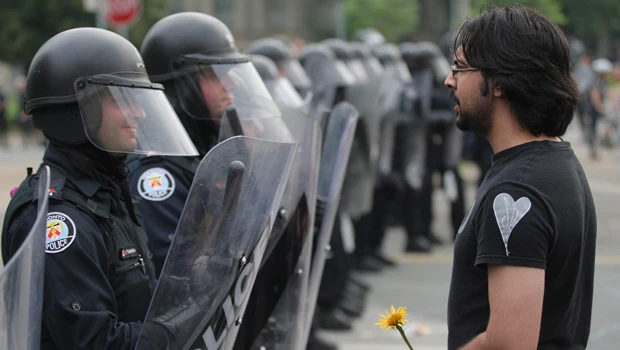
The Streetcar 511 — that has been taking me all these days from Bathurst to within a walking distance to the center, stopped some 500 meters before the routine. Enhanced security following the ‘black Saturday’ would not let it stop near the Media Center, I was told. Policemen and women in full riot gear were at all entry points. And as I passed by the Fort York entrance, the security presence was full. It is not back to normal — as yet.
Security is big business. It has always been. Yet it irks many — and not least the protesters. For they have their own reasons to be furious. When US President Barack Obama landed at Toronto Airport, a large number of people in immaculate suits and dark sunglasses were conspicuous. It was so typical of the US President’s security team — keeping a vigil on the surroundings — looking suspiciously at every movement. And this costs — and costs a lot.
Ball park expense figures spent on arranging the summit vary. Initially a figure of $1 billion was mentioned. Included indeed was the huge media center, where press men and women enjoyed reclining around an especially, created for the event, artificial lake, so as to provide a taste of the real Canada to the media men and women converging from all around the globe. In fact this media pavilion became emblematic of what many Canadians — and indeed the protestors — viewed as the financial wastefulness of the G20 enterprise.
However, expenses far overshot the original estimates. The country had to spend something around $1.2 billion, just on providing security to the leaders. “My estimate, what I’m hearing, is over $1 billion, $1.2 billion on security features for G20,” George Spezza, the city’s Economic Development, Culture & Tourism said in an interview. Overtime pay alone for the Canadian police deployed at the G8 and G20 summits made up a large chunk of the budget — some $450 million .
And this is exactly what made a number of protesters furious. And they had reasons to be so. Despite tall claims of promoting maternity and child health, in poor countries, Prime Minister Stephen Harper of Canada announced a sum of $1.1 billion to promote maternal and child health care in poor countries. Many felt it was paltry — when compared to the expenses incurred on providing security for the visiting leaders.
Yet despite all the security related expenses, Toronto experienced one of the worst upheavals in recent history.
And the expense issue didn’t escape the leaders’ attention too. The question of possible expense was posed to none else than French President Nicolas Sarkozy, the next host of the event. And this irritated him. Reacting to the question, he apparently over committed himself: “The bill for next year’s G8 and G20 summit meetings in France won’t be as steep as this year’s.”
And then he added what could keep haunting him for some time. He emphatically said that the next year’s meetings will cost “10 times less” than those currently taking place in Canada — indeed easier said than done.
And a lively debate on why G8 preceded the G20 continued too. Some felt, the G8 took decisions — and just wanted the G20 to endorse them. And this, some felt, gave a fillip to the protests here and what the city witnessed on the day, being referred to here as ‘black Saturday,’ was something unheard of in this part of the world. In fact it reminded me of the violent protests, clashes and marches, generally witnessed in the subcontinent — on the streets of Karachi, Lahore, Mumbai and Delhi — rather than Toronto.
And covering the riots posed unique challenges too. Kathy English, the public editor at Toronto Star said, “It’s not every day that reporters and photographers are sent out into the streets of Toronto equipped with helmets and gas masks. But of course, it’s not every day that Toronto plays host to the world’s most influential leaders.”
By afternoon, the protests had turned violent. Roving bands of protesters rampaged through the city, torching three police vehicles in the process and smashing windows, as terrified people ran for cover.
A newspaper photographer was shot with a rubber bullet, while another had an officer point a gun in his face despite identifying himself as a member of the media. At Queen Street and Spadina Avenue at least three protesters — one wearing what appeared to be a fake police shirt — started smashing a police car with a two-by-four and setting a second police car on fire.
And life in Toronto was disturbed — coming to a grinding halt in downtown. Street cars — the replica of tram services — went off the road. Subways between down town and the east of the city got disrupted. And I— had to walk for miles to get out of the Media Center, before being fortunate enough to find a taxi. And there were people on the street — waving at each passing taxi.
Protesters were apparently furious at the capitalistic model. But those who were not out on streets protesting were also not much behind. At the Media Center too — while on one side, a section was engrossed in closing in on the uneasy, ugly developments in the downtown, another section was keeping a tab on the US-Ghana football match. And all of a sudden there was a huge roar of applause. Ghana had scored another goal over the US — and the anti-imperialistic streak in some media men and women here came out in terms of a loud outburst. Otherwise one is sure all those watching the match were definitely not Ghana supporters.
Toronto has changed overnight!