
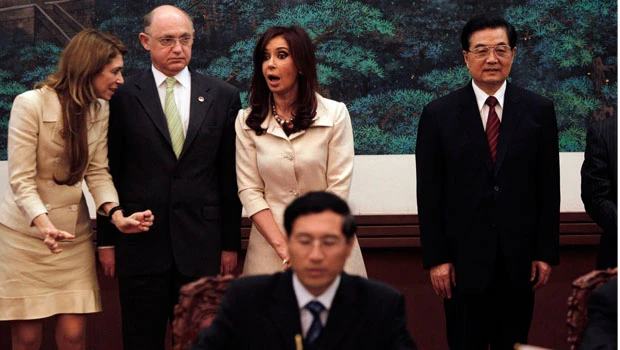
- BEIJING: Argentina and its visiting president appeared to make no progress Tuesday against China's monthslong ban on soy oil imports that has hurt one of the South American country's key trade products.
China played down the ban and called it a normal trade dispute. Argentine President Cristina Fernandez and Chinese President Hu Jintao signed a dozen cooperation and trade agreements Tuesday, but none of them was about soy oil.
The soy dispute is the most pressing issue for Fernandez, who is making the first trip to China by an Argentine president since 2004.
The visit should have been earlier. Just after meeting Hu, Fernandez apologized three times for postponing a planned January visit due to domestic political troubles.
“Believe me, at the time I felt regretful,” Fernandez said.
The agreements signed included on cooperation between state-owned Chinese oil producer Sinopec and Argentina's state-operated Enarsa energy company. No further details were given.
The Argentines had said they would sign some $10 billion in cooperation agreements and trade deals with China involving various industries.
One business issue that went unmentioned publicly Tuesday was the possible sale by British Petroleum Corp. of its 60 percent share in Pan American Energy, an Argentine oil and gas producer. That stake is worth some $9 billion and has a ready buyer in CNOOC, China's state-owned China National Offshore Oil Corporation, which already has a 20 percent stake in Pan American and is looking to expand holdings overseas to provide more energy for China's booming economy.
Those energy needs have helped China forge strong commercial ties with Latin America after decades of relative neglect. China's push into the region also includes the hunt for farm goods like soy to fuel its feverish growth.
Argentine exports of soy oil to China totaled $1.4 billion last year, accounting for a sizable chunk of two-way trade that strongly favored Beijing.
China placed the ban on soy imports on April 1, after saying it found shipments containing excessive levels of hexane, a potentially cancerous chemical used in soy processing. But the restrictions also came after Argentina last year imposed antidumping measures on some China-made goods.
China has denied the soy ban is a retaliatory measure, while Argentina has said its soy products are not contaminated.
When asked Tuesday by reporters about the soy dispute, a Chinese Foreign Ministry spokesman called Argentina an important partner in Latin America and said the problem should be resolved.
“Regarding the import of soybean oil to China, it's just a normal problem that comes with the development of trade and economic relations,” the spokesman, Qin Gang, told a routine media briefing. “I believe as long as the two countries follow the spirit of cooperation and mutual benefit and through friendly consultation, a proper resolution will be found.”