
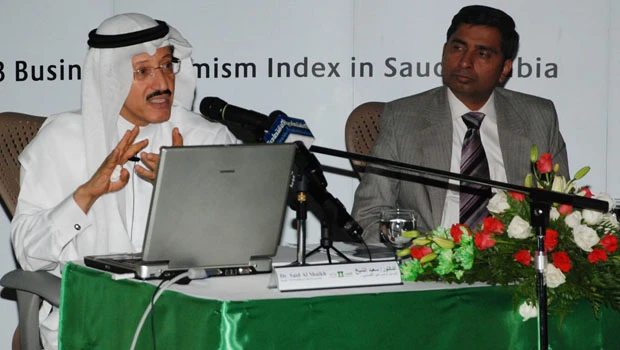
- RIYADH: Saudi Arabia's hydrocarbon sector optimism has increased substantially for the third quarter, while the Kingdom's economy is marching ahead and projected to rebound sharply during the current year.
- The same trend of growth in the Saudi economy will continue during the next two years because of higher oil production and heavy public spending as well as support extended by government agencies and private sector.
Addressing a press conference on the occasion of the release of Business Optimism Index (BOI) for Saudi Arabia for the third quarter of 2010 here Tuesday, Said Al-Shaikh, senior vice president and chief economist of the National Commercial Bank (NCB), said that the composite optimism index for hydrocarbon sector has improved significantly.
Al-Shaikh also spoke about lending and loan syndications by Saudi commercial banks at the press conference. He said that the Saudi banks had not been financing overseas projects, rather they had been concentrating on domestic ones. He said that there was no significant direct impact of Greek or European financial crisis on Saudi banks.
Spelling out the highlights of the BOI survey, Al-Shaikh said that the global financial markets faced headwinds for the second time this year on mounting fears that euro zone debt troubles could severely impact the nascent global economic recovery. Oil prices witnessed yet another quarter of wide fluctuations, as prices touched highs of $84 on growing confidence that global economic recovery would stay robust, but then corrected by a significant 20 percent from that peak to $66 during May's downturn in sentiment.
Referring to the hydrocarbon sector, he said that "the BOI survey reveals the improvement in optimism level." The survey, however, said that "the crude oil prices continued to face wide fluctuations during the second quarter on the back of another round of worries encompassing euro zone sovereign debt." So far as the non hydrocarbon sector is concerned, it may slightly decline in demand levels in comparison to the previous quarter, said the BOI survey.
The outlook for level of selling price, which has remained in line with the recently recorded year high inflationary figure of 5.4 percent in May, has fallen for the first time in the last four quarters.
Referring to the factors impacting business, the survey said that the raw material costs would remain the most important business concern in third quarter. A total of 44 percent of the non-hydrocarbon respondents have cited it as the key business factor which might impact their businesses, said the survey. Availability of finance also continues to be an important challenge as 32 percent expect it to impact their business in the third quarter, the survey noted.
To this end, the survey has revealed that 40 percent of the firms have announced plans to invest in business expansion. Al-Shaikh said "while global economic recovery is predicted to continue, it was apparent that the downside risks had increased recently, following Europe's sovereign debt troubles."
"Growing concern over the ability of Greece and other European states to service their sovereign debt has weekend confidence in recovery, causing greater volatility in global financial and commodity markets including oil," he added.
Pawan Bindal, associate director of Dun & Bradstreet, who was also present during the ceremony, said that "the recent sovereign debt issues in Europe and the typical slowdown in business activity in the Kingdom over the summer months have depressed non-hydrocarbon business optimism for third quarter."
The hydrocarbon sector business optimism has increased supported by a strong oil price expectation and will facilitate the government's commitment to capital spending thus stimulating the Saudi economy, he added.