
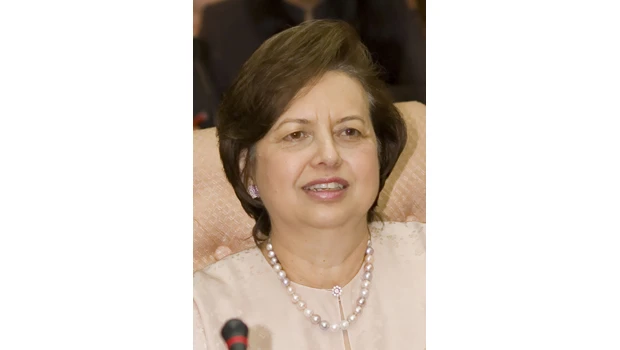
- Zeti Akhtar Aziz, the Governor of Bank Negara Malaysia (BNM), the central bank, has called on the global Islamic finance industry to recognize the forces of change and the transformation taking place in the international financial system and global economy and to continue to evolve to remain effective and competitive.
"Islamic finance has come a long way and is set to continue its trajectory upward and onward. An important aspect of the recent developments to strengthen Islamic financial services industry is that this is being undertaken during the stable and good times. This will position Islamic finance to deal with future challenges. A clear indication of that is the growing relevance and importance of the sukuk market," she told guests at the annual luncheon of The Asset Triple A Awards for Islamic Finance which was held in Kuala Lumpur in July.
The awards recognized the best achievements and centers and institutions of excellence in several categories in the Islamic finance industry in the past year. In fact, Gov. Zeti herself won the "Industry Leadership Award" and Malaysia won the "Islamic Finance Hub of the Year". The "Best Islamic Project Finance Deal" Award went to the $194.5 million Islamic finance facility for the Arabian Amines Petrochemical Project, a joint venture between Saudi Arabia's Al-Zamil Group and the US-based Huntsman Company, which was arranged by Saudi Hollandi Bank. This facility was the only wholly-Islamic project financing facility for the oil and petrochemical sector in the Kingdom to date. Similarly, the "Best Islamic Hedging Facility" was the $2.2 billion profit rate swap coordinated for Zain KSA by syndicate of banks including Arab National Bank, Banque Saudi Fransi, Credit Agricole CIB, Saudi British Bank and Standard Bank plc.
In her speech titled "The Global Islamic Financial Market Today: Challenges and the Way Forward", Zeti stressed that the Islamic financial system did not exist in isolation and would continue to develop as an integral part of the global financial system. Islamic finance has experienced its most rapid pace of development in this decade demonstrating its competitiveness and resilience as a form of financial intermediation. While the Islamic assets are now more than $1 trillion, it is estimated that the global Islamic finance industry will reach the $2 trillion mark in the next three to five years.
Two important developments, according to Zeti, are the establishment of a task force on Islamic Finance and global financial stability and a task force on liquidity management by the Islamic Development Bank (IDB) and the Islamic Financial Services Board (IFSB).
The first task force published a report in April this year which recommended the establishment of an Islamic Financial Stability Forum (IFSF) based at the IFSB as a platform for productive dialogues to promote financial stability in the IFS, and for it to interface with the conventional system via the Financial Stability Board to facilitate the common objective of achieving global financial stability.
The second Task Force charged with the mandate to develop a liquidity management scheme at both national and international level is expected to make key announcements later this year to facilitate cross border liquidity flows for efficient resource utilization by Islamic financial institutions.
Zeti is confident that Islamic finance will continue its progress. "An important aspect of the recent developments to strengthen the Islamic financial services industry is that this is being undertaken during the stable and good times. This will position Islamic finance to deal with future challenges. A clear indication of that is the growing relevance and importance of the sukuk market", she added.
She commended the rapid progress of the industry over the last decade - Islamic assets total over $1 trillion, and are estimated to reach $2 trillion in the next few years. Sukuk are now internationally-acceptable instruments. Issuers are seeing the sukuk instrument as an alternative means for raising capital, whilst investors are increasingly seeing it as a new asset class.
The sukuk market totals about $130 billion, with a growth rate of about 40 percent annually. Despite a challenging environment, new issuance of Sukuk in the global sukuk market rose by 43 percent to $20 billion in 2009. However, developments in Europe resulted in a more cautious market and the global sukuk issuance declined by 20 percent in the first half of 2010. In the coming period, this trend, said Zeti, is expected to improve as governments in Asia and the Middle East have already initiated the raising of funds for the implementation of infrastructure development and investment projects.
The extensive interest in Islamic finance from different parts of the world too is driving the international dimension of Islamic finance, with greater involvement of international and regional financial centers, multinational corporations, micro enterprises and ordinary customers.
Similarly, organizations such as the IFSB have developed prudential standards ranging from capital adequacy requirements to standards for governance and risk management for the global Islamic finance industry, and there has been a proliferation of education and courses in Islamic finance offered by major institutions of higher learning and training organizations from around the world. There has also been progress in greater convergence in Shariah interpretations between jurisdictions which is bound to enhance the potential for product harmonization and cross-border transactions.
Zeti highlighted the challenges faced by the Islamic financial industry. Despite the fact that the funds managed in the Islamic financial system are still only a fraction of the total assets of the international financial system, they are uniquely supported by underlying productive economic activity and capacity that connects with the real economy as required by Shariah principles and contributes to income and wealth creation. Not surprisingly, the Islamic financial industry has weathered the global financial crisis relatively well, and this has thus brought about a greater appreciation amongst the international financial community on the distinct nature and in-built strengths of Islamic finance.
In addition, the profit sharing and risk sharing characteristics in Islamic finance strengthen the incentives for the financial institutions to ensure the profits are commensurate with the risks being assumed. "It is this form of finance", emphasized Zeti, "that we would want to encourage".
Another two major challenges are the development of an active secondary global sukuk market and human capital to sustain innovation and R&D in the industry.
There has been a lack of trading in the secondary market especially in the US dollar sukuk market as the investors tend to buy-and-hold the instruments until maturity. This is largely due to the scarcity of the instruments in the market. But in Malaysia, the growing ringgit sukuk market has resulted in an active secondary market. This is largely due to the regular and varied issuances throughout the year, which is further supported by investment in R&D and in human capital development to ensure the next generation of expertise in structuring sukuk and documentation.
"This is an area of focus in Malaysia to develop the skills, expertise and capability. The Islamic financial system in Malaysia now offers a wide range of financial products and services that are competitive and able to meet the changing requirements of the domestic and global economy," she concluded.