
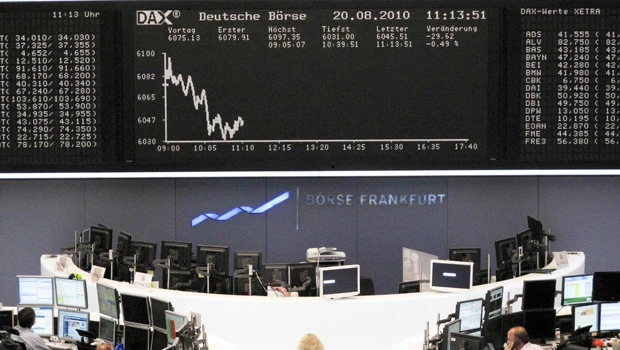
- LONDON: European stocks fell at midday on Friday, and were on track to end lower for a second straight week, as traders worried about the effects a slowdown in economic growth will have on corporate earnings.
At 1048 GMT, the FTSEurofirst 300 index of top European shares was down 0.9 percent at 1,027.42 points, falling for the third straight day, and having hit its lowest level in a month. The index is on track to record a 1.7 percent loss on the week, and is in negative territory for 2010.
Weak US economic data and high levels of debt in Europe are worrying investors. “The market is falling on concerns about GDP growth going forward,” said Dean Tenerelli, fund manager at T Rowe Price. “It’s about the effect of a US slowdown and uncertainty and how earnings will look in 2011, when austerity kicks in, though in general, results have been good.” Wall Street fell to its lowest close in nearly a month after a report showed factory activity in the mid-Atlantic states contracted in August for the first time since July 2009, and the Labor Department said first-time claims for jobless benefits rose to a nine-month high.
In a broad market decline for European shares on Friday, the heavyweight banking sector was a major drag on the index.
Banco Santander, BBVA and UBS fell 1.3 to 1.4 percent. Insurers to fall included Allianz, down 2.2 percent.
Crude prices fell 1 percent to $73.70, partly due to a stronger dollar, hurting energy shares.
StatoilHydro fell 1 percent. BP fell 2.2 percent, down for the fifth day. US officials said on Thursday the company likely won’t put the final plug in its blown-out Gulf of Mexico oil well until September, while scientists said the oil spill left a large plume of hydrocarbons in deep waters, and those chemicals could be there for some time.
But it was the energy sector that provided the strongest gains for individual companies.
Dana Petroleum rose 5.9 percent, after state-run Korea National Oil Corp. (KNOC) made a hostile $2.9 billion cash bid.
BG Group rose 4.7 percent, as rumours resurfaced it may attract a bid from Royal Dutch Shell, which fell 1.1 percent.
Around Europe, UK’s FTSE 100 index, Germany’s DAX index and France’s CAC 40 fell between 0.7 and 1.1 percent.
The Thomson Reuters Peripheral Eurozone Countries Index was down 2.3 percent, with Spain’s benchmark IBEX down 1.7 percent.
Holcim fell 2.6 percent, adding to a 6.3 percent fall in the previous session, when the world’s second-biggest cement maker posted disappointing first-half earnings. Credit Suisse cut its target price for the shares.
“Holcim has been another reason for the market falling,” said T Rowe Price’s Tenerelli, “reminding people about the lack of infrastructure spend.”
The Euro STOXX 50, the euro zone’s blue chip index, was down 1.1 percent at 2,646.90 points, piercing a key support level, the 38.2 percent retracement of the index’s fall from a high in April to a low in May. The index’s next major support level is 2,584.75 points, the 23.6 percent Fibonacci retracement.
“The latest data out of the US sparked a flight to quality by reviving fears of a double-dip recession, with investors seeking refuge into safer government debt,” Louis Capital analyst Bertrand Michaud said.