
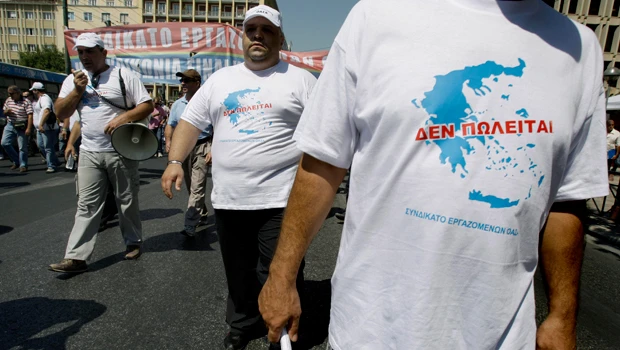
- ATHENS: A wave of anti-austerity strikes hitting Europe this autumn will disrupt life and may hurt some economies but is unlikely to topple governments or shake their resolve to push on with tough salary and pension cuts.
Unions have seen their influence wane in recent decades, analysts say, and cannot muster huge support among people who realize belt-tightening is necessary to exit a financial crisis across the continent.
“The public in many European countries realizes that there is a need for austerity measures,” Blanka Kolenikova, analyst for Europe at IHS Global Insight told Reuters. “If governments don’t cut spending, they might face problems similar to Greece.”
In a show of strength, French unionists summoned by their estimates over two million people on Tuesday to participate in nationwide walkouts against pension reform. The official count was 1.12 million.
But analysts said whatever the numbers, their victory was largely symbolic and unlikely to sway President Nicolas Sarkozy.
Millions of Londoners walked or biked to work on Tuesday as rail workers went on strike to protest austerity-driven jobs cuts, mirroring action already taken in other European countries striving to cut deficits and debts run up during recession.
Governments in Greece, Spain, Italy and Romania have also been rocked by strikes against tax hikes, pay and spending cuts and workers are preparing a new a wave of walkouts after the summer lull, including pan-European action on Sept 29.
In Greece, a flashpoint of violent protests that left three bank workers dead in May, unions are launching a season of rallies and strikes this weekend in the northern city of Thessaloniki, where Prime Minister George Papandreou is due to outline economic policy.
“People have yet to feel the full brunt of austerity,” said Ilias Iliopoulos, general secretary of the ADEDY public sector union. “We expect participation in Thessaloniki to be big, to launch a new start to our struggle.”
The debt-ridden country, whose huge deficits prompted a sovereign debt crisis in Europe this year, has been rocked by strikes even during the summer, with seamen and truck drivers blocking ports and roads, hurting its key tourism industry.
Although strikes can be disruptive and hurt fragile economies like that of Greece, analysts say governments will stand their ground. In central and eastern Europe, many nations are in the grip of IMF negotiations and have little leeway.
Even in countries with a strong labour tradition like Britain, where miners’ strikes forced a snap election in 1974, unions have seen membership fall and influence wane.
“The days when the unions could hold the government to ransom in any serious and long term way are behind us — but that’s not to say there couldn’t be some incredibly serious disruption,” said professor Justin Fisher, political analyst at London’s Brunel University.
Leftist-controlled labor unions are also loath to create too much trouble for socialist governments in countries such as Greece and Spain, traditionally more sympathetic to the workers’ plight than conservatives would be.
In some countries, like Ireland, unions have mustered unusually large participations in protests against draconian austerity but labor leaders have said they want to avoid major disruptions for fear of deterring bond investors.
Concerns about the political and economic health of euro zone periphery countries Greece and Spain sent global markets reeling in spring and forced governments to take even harsher measures.
In Spain, slowly emerging from one of the deepest recessions in Europe after its real estate bubble burst, participation in strikes has declined and labor and social security reforms will be approved in parliament this week.
But, although spared the violent protests of Greece, Spain’s minority government has seen its austerity package eat away at potential support from leftist parties, hurting Prime Minister Jose Lous Rodriguez Zapatero’s ability to legislate effectively.
Analysts said the biggest risk comes from protests by young people, who are not controlled by unions and suffer the most from rising unemployment. In Spain over 20 percent are jobless. Greek unemployment in the 15-24 age group was 32 percent in May.
“Young people are more sensitive to the difficulties, more worried about the future,” said Costas Ifantis, political scientist at the University of Athens. “They could spearhead protests, as they’ve done in the past.”