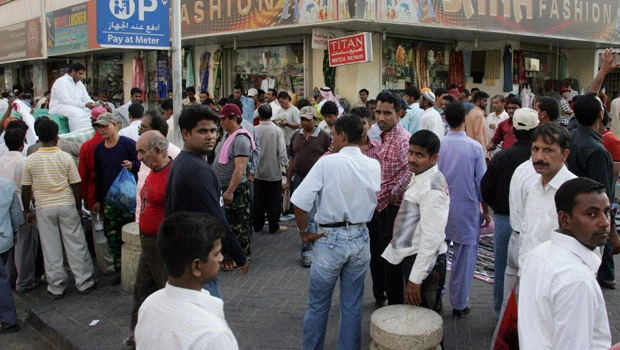
- DAMMAM: With its abundance of shops, offices and small hotels, the center of Dammam, popularly known as Seiko, is a lively place most of the time.
- But during Eid, it teems with thousands of foreign workers far from home with little to do.
“We come here to celebrate Eid with our friends,” said Shaikh Shakiruddin from Sylhet in Bangladesh. “This place is very colorful and convenient because it is in the middle of town.”
Being away from near-and-dear ones on Eid day is very difficult, he says as tears well in his eyes. He immediately grabs his wallet and kisses a tiny photo of his two children. “I miss you all.”
The city center begins to fill up with foreigners every Eid, with the Bangladeshis usually arriving first. The Indians and the Pakistanis show up in force in the late afternoon.
The city center offers much to attract foreign nationals. The lanes are home to a Subcontinent bazaar selling everything from “biryani” and “nehari” to the latest movies from Bollywood and Urdu dramas from Lahore and Karachi. The warren of buildings also houses telephone call centers where expatriates make countless calls back home. In some of the lanes, you can still see the old, pay telephones -- once the only link with home for many.
“In the pre-mobile phone days, we would line up at these stands to make calls to our near-and-dear ones. It would take hours sometimes to get our turn,” said Dilawar Muhammad from Karachi. “Making a call home in those days was quite a task. First we had to convert our bills into one-riyal coins. Then every one of us would hold a plastic bag full of coins and stand in the long queue. There was no privacy, and there was no room to exchange sweet nothings with your better half on Eid day,” he said.
“The interesting part was the people back home had no idea where and in what condition were we calling. Now, with these cell phones we can call any time and in complete privacy,” Muhammad said. “Technology has changed, and it is easier to connect with folks back home. What have not changed are our feelings; they are the same. We were homesick then, and we are still homesick now. The children have grown, and on every Eid we still live in a bubble.”
The city center has several shopping malls ranging from the posh to the popular. Many shops specialize in travel bags, suitcases, footwear and electronic products, and just off the main road, there is an open area where you can sit down and savor the breeze while enjoying a sandwich with a soft drink supplied by one of several Keralite-run kiosks.
Not all men gathering here readily talk of homesickness, at least not in conversations with a journalist. Nevertheless, the feelings show indirectly in many ways. A man from Multan in Pakistan’s Punjab province politely steers the discussion away from talk of his hometown and instead launches into a monologue about his work as an accountant at a fast-food restaurant.
Longing for home may also be detected in the way some foreigners stress that their work here enables them to save money. For them, their work here enables them either to start a business back home or to keep their children in good schools. However, many expatriates say they are unable to save much as all their remittances are spent to provide for their families.
Schoolteacher Mushfiqur Rahman says he is married and that his wife, Faeza, and their two children, Talha and Taha, live in the north Indian city of Lucknow. A wiry, cheerful man, Rahman is accompanied by a friend who leaves most of the talk to him but laughs at his frequent jokes. The two openly admit they are homesick.
“It is tough being away from family on Eid day,” Rahman said. “It is too much to bear and, therefore, we sleep most of the time during these holidays.”