- RIYADH: Millions of Muslims across Saudi Arabia, including a large number of expatriate workers and pilgrims, celebrated Eid Al-Fitr on Friday, marking the end of the fasting month of Ramadan.
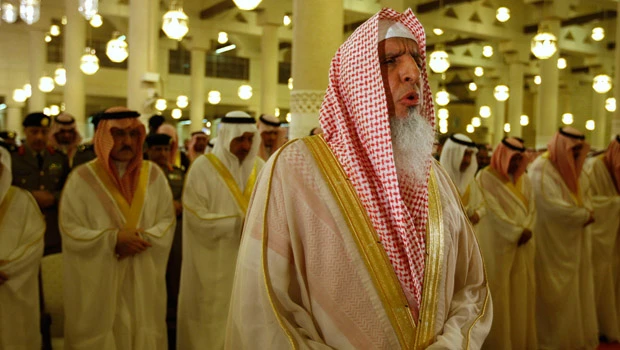
In Riyadh, acting Gov. Prince Sattam joined citizens and expatriates in offering Eid Al-Fitr prayers at Imam Turki bin Abdullah Mosque Friday morning.
The large congregation was led by Grand Mufti Sheikh Abdul Aziz Al-Asheikh and was also attended by several members of the royal family, ministers, Islamic scholars, senior Saudi officials and a large number of newsmen and press photographers.
Al-Asheikh called upon Muslims “to follow the teachings of Islam in their daily lives and to imbibe the true spirit of religion in order to face challenges ahead.” He called on the people around the globe to “understand Islam properly and in totality, which teaches tolerance, peace and brotherhood.”
After the prayers, Prince Sattam exchanged greetings with royal family members, officials and citizens.
Sheikh Saleh Bin-Humaid led Eid prayers at the Grand Mosque in Makkah while Sheikh Ali Al-Hudaify led the prayers at the Prophet’s Mosque in Madinah.
“Despite the weakness, backwardness and division among Muslims, it is still the most powerful driving force known to mankind,” Bin-Humaid said in his Eid sermon.
Sheikh Al-Hudaify emphasized the importance of Ramadan in reforming minds of the faithful, adding that it teaches them to follow God’s order.
Elsewhere in the capital city, Eid prayers were offered in 22 open places and 440 mosques.
The Ministry of Islamic Affairs identified the open areas and mosques to ensure the smooth offering of prayers and to minimize crowding around the mosques, but there were complaints about traffic jams in some parts of the city.
“Roads leading to the Riyadh Air Base Eid grounds were clogged and there was chaos,” said Saquib Manzer, who attended the prayers there.
In Jeddah, Eid prayers were held in mosques and prayer grounds in different parts of the city. Sheikh Muhammad Al-Masoud, who led the prayers at the vast Eid ground at Kilo 2 along Makkah Road, urged the faithful to fear God both in their secret and open lives.
In the Eastern Province, Eid prayers were offered at various mosques in Dammam, Dhahran, Alkhobar, Jubail, Ras Tanura, Al-Khafji and Hafr Al-Batin.
The biggest Eid congregation was at the grand King Fahd Mosque in the center of Dammam. Here the Eid prayers were attended by Gov. Prince Muhammad ibn Fahd, Deputy Gov. Prince Jalawi bin Abdul Aziz bin Musaed and senior security and government officials.
The weather was humid in the morning but as the day wore on it became pleasant prompting many families to head to the beaches for fun and frolic.
In Tabuk, Sheikh Saud Al-Yousuf, chief justice of the province, led the main prayer congregation.
“The holding of Eid prayer all over the world reflects the unity of Muslims,” Al-Yousuf said.
Malls and hypermarkets in Riyadh were bursting at the seams as the crowds jostle to finish last-minute shopping until 4 a.m. on Friday.
Due to the last minute rush, there were traffic jams on major roads and streets of the city. Shopping malls like Balsharaf Supermarkets, Panda, Carrefour and Othaim Markets reported good sales.
Traditional shopping hubs for expatriates like Batha and Hara in the capital city remained open till the wee hours of the night.
“We have got an additional day for shopping,” said Yunus Khan, an Indian executive, while referring to the Eid being celebrated this year after 30 days of fasting.
“Every year, we entertain dozens of guests on Eid and it is great to catch up with relatives and friends,” said Zayed Karim, an Arab expatriate.
He said that the spirit of celebration touches one and all, be they Muslims or non-Muslims.
Many are, however, not so lucky as to be surrounded by their loved ones.
Mohammed Shahnawaz, who works for Saudi Investment Bank here, could not go to India for the Eid celebrations with his family.
“It’s tough to stay away from your family and friends on Eid,” he said. Shahnawaz sent a box of gifts for his family and relatives.
On Friday morning before Juma prayers, people were seen visiting their friends and relatives to exchange Eid greetings and eating sewai-based dishes, including zarda, phirni, sheer khurma, lachha and Benarasi sewai by north Indian families. To offset the excessive sweetness, other dishes like dahi-vada and chhole were also prepared.
The steady stream of guests on Eid ensures that the enthusiasm meter does not dip. Eid celebrations transcend the barriers of national boundaries, religions and physical distances, while it binds the mankind in one thread of love and brotherhood.