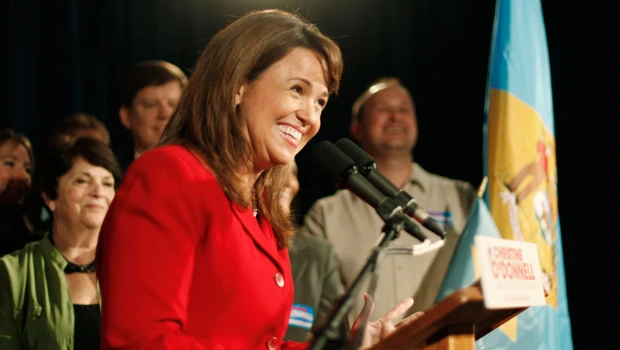
- WASHINGTON: A little-known conservative activist backed by the independent tea party movement won Delaware's Republican Senate primary, dealing a blow to the party's prospects for winning control of both chambers of Congress.
The victory by Christine O'Donnell was the latest sign of upheaval in a political season shaped by economic pain and exasperated voters. The grass-roots, anti-establishment, anti-tax tea party movement can claim wins in at least seven Republican Senate races, a handful of the party's gubernatorial contests and dozens of House primary campaigns.
The success of O'Donnell and some of other candidates backed by the tea party movement may hurt Republicans' chances of gaining the 10 seats they need to win control of the Senate in the Nov. 2 general election. The Republicans are in a better position to gain the 40 seats they need to take control of the House of Representatives.
Republicans had seen Delaware as one of their best prospects for capturing a seat from Democrats. But O'Donnell is less likely to attract the Democratic and independent votes needed to win the seat held by Vice President Joe Biden for 30 years. Republicans Party officials have suggested they would not give O'Donnell funding against her Democratic opponent, Chris Coons.
Democratic national committee chief Tim Kaine told NBC television on Wednesday that O'Donnell's win was a sign of the "civil war" in the Republican party. "That creates opportunities for us," he said.
With unemployment high and Democratic President Barack Obama's popularity below 50 percent, polls are predicting major gains for Republicans in both the House and the Senate. The tea party movement has energized conservatives and could lead to a strong turnout for Republican candidates.
But Democrats hope Republicans will be saddled with ultraconservative candidates, like O'Donnell, who may be too extreme for moderate voters. Tea party-backed candidates earlier won Republican Senate nominations in Nevada, Colorado, Florida, Kentucky and Alaska.
In the fight for New Hampshire's Republican Senate nomination, a second tea party insurgent trailed in vote counting that was still going on Wednesday. After lagging in early returns, former Attorney General Kelly Ayotte moved ahead of Ovide Lamontagne with a lead of roughly 1,000 votes, with results tallied from 85 percent of precincts. Ayotte was backed by establishment Republicans while Lamontagne, a former chairman of the state Board of Education, campaigned with the support of tea party activists.
The winner will face Democratic Rep. Paul Hodes, who is giving up his House seat to run for the Senate seat of retiring Republican Sen. Judd Gregg.
New Hampshire's Democratic Gov. John Lynch rolled to renomination for a fourth term, and he will face Republican John Stephen, a former state health commissioner.
In New York, tea party ally Carl Paladino dealt another shock to the Republican establishment, defeating former Rep. Rick Lazio in the race for the party's nomination for governor. Paladino will face state Attorney General Andrew Cuomo, the prohibitive favorite.
Lazio still won the Conservative Party nomination and a spot on the November ballot anyway.
With all precincts reporting in Delaware, O'Donnell had 53 percent to 47 percent for Castle, a former two-term governor and the longest serving congressman in Delaware history.
O'Donnell thanked conservative Sarah Palin and tea party groups for their endorsement.
"The people of Delaware have spoken: No more politics as usual!," she told cheering supporters.
But her future Democratic opponent, Coons, issued a statement moments after Castle's defeat. "We cannot let Joe Biden's seat fall into ultraconservative hands," he said.
Castle's defeat boosted the number of members of Congress who have lost primaries to eight, five Republicans and three Democrats. There is also a lengthy list of Republican contenders who fell to tea party-supported challengers despite having the backing of party officials.
O'Donnell will enter the campaign as an underdog to Coons, a county executive who was unopposed for the Democratic nomination for the seat long held by Vice President Biden.
The Republican state chairman, Tom Ross, said recently that O'Donnell "could not be elected dogcatcher," and records show that the Internal Revenue Service had once slapped a lien against her and that her house had been headed for foreclosure.
Wisconsin businessman Ron Johnson defeated two minor opponents for the Republican nomination to oppose three-term Democratic Sen. Russ Feingold in November in what polls show is a tight race.
In New York, Democratic Rep. Charles Rangel, a 40-year House veteran, easily won renomination in his first time on the ballot since the House ethics committee accused him of 13 violations, most of them relating to his personal finances. A second New York Democratic incumbent, Rep.
Carolyn Maloney, won easily in another contested primary.
And Washington D.C. Mayor Adrian Fenty was booted from office by primary voters, despite spending weeks apologizing for what he conceded was arrogant behavior across four years in office. City Council member Vincent Gray outpolled Fenty and is virtually assured of victory in November.
In all, five states chose nominees for the Senate Tuesday, and six more had gubernatorial hopefuls on the ballot in the final big night of the primary season.
In Maryland, former Republican Gov. Bob Ehrlich defeated a tea party-backed political novice to win the nomination for a rematch against the man who ousted him from office in 2006, Democratic Gov. Martin O'Malley.
In Wisconsin, Milwaukee County Executive Scott Walker defeated former Rep. Mark Neuron for the Republican nomination for governor. Milwaukee Mayor Tom Barrette won the Democratic nomination.
Rhode Island had a rare open seat in its two-member House delegation, following the decision of Democratic Rep.
Patrick Kennedy, the son of the late Sen. Edward Kennedy, to retire. Providence Mayor David Cicilline, who is openly gay, defeated three rivals for the Democratic nomination.
The tea party movement emerged after the election of Obama as a loose-knit coalition of community groups largely made up of people with conservative and libertarian views who say government has grown too large and spends too much.
The movement's name is taken from the Boston Tea Party, a 1773 protest in which American activists boarded ships and threw their cargo of English tea into Boston Harbor to protest taxes imposed by Britain.