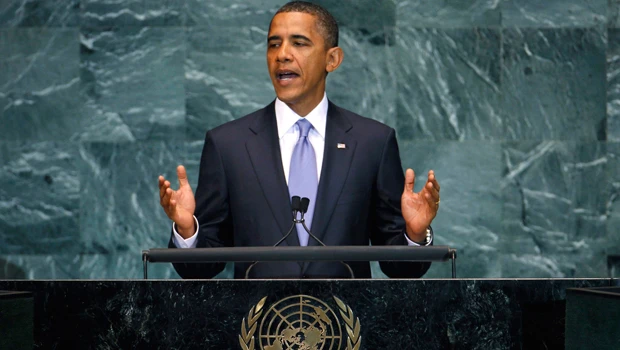
- UNITED NATIONS: President Barack Obama warned Thursday the Holy Land was doomed to perpetual bloodshed, unless the world unites behind his plan for a Palestinian state and a secure Israel within a year.
Obama, in a speech to the UN General Assembly, urged fellow world leaders to press forward with renewed determination in the quest for Mideast peace, an effort that he acknowledged has encountered “few peaks and many valleys.”
As Obama spoke, Israel’s seat in the hall sat empty. The reason for this given by Israeli representatives was that Thursday was a Jewish holiday. But according to various media sources and Middle East watchers, the Israelis wanted to snub Obama by remaining absent.
Palestinian President Mahmoud Abbas was present, listening to the president through a translator’s earphone. Obama’s call for a Palestinian state drew a burst of applause from throughout the hall.
Obama’s one-year timeline is ambitious even if the Mideast peace process faced the best of circumstances, which it does not. He made no mention of the Hamas movement, which controls the Gaza Strip and refuses to accept Israel’s right to exist.
Obama spoke with resolve of the need to address trouble spots around the world, but he tended first to the economic concerns that abound both at home and abroad.
“There is much to show for our efforts,” he said, recalling the economic turmoil of years past.
“We cannot — and will not — rest until these seeds of progress grow into a broader prosperity for all Americans and for people around the globe.”
On a pressing security issue, Obama defended his administration’s approach to engaging Iran in negotiations over its nuclear program — an effort that has failed thus far. In July the administration imposed a new set of sanctions on Iran.
“The door remains open to diplomacy should Iran choose to walk through it,” he said. “But the Iranian government must demonstrate a clear and credible commitment and confirm to the world the peaceful intent of its nuclear program.”
Obama also spoke to the promotion of human rights, open government and democracy — familiar themes from a president who has pushed for international cooperation against repression and tyranny.
“Make no mistake: The ultimate success of democracy in the world won’t come because the United States dictates it. It will come because individual citizens demand a say in how they are governed,” he said. “There is no soil where this cannot take root.”
Obama drew applause in mentioning UN efforts to protect the rights of women, and he urged all nations to act against oppression.
“Do not stand idly by, don’t be silent when dissidents everywhere are imprisoned and protesters are beaten,” he said.
The president devoted his greatest attention to the Israeli-Palestinian conflict, underscoring the urgency of overcoming the hurdles that he has met less than a month after relaunching direct negotiations between the parties.
Obama urged the UN in its 60th year to look beyond past Middle East peace failures and get on with the task at hand.
“We can come back here, next year, as we have for the last 60, and make long speeches about it,” he said. “We can read familiar lists of grievances. We can table the same resolutions.”
“Or we can say that this time will be different, that this time we will not let terror or turbulence or posturing or petty politics stand in the way.”
Obama’s speech came amid a three-day UN-dominated trip to New York, where the US president was meeting privately with the leaders of China, Japan, Colombia, Azerbaijan and Kyrgyzstan.
In addition, he was to host Southeast Asian leaders and attend a meeting aimed at preventing renewed civil war in Sudan.