
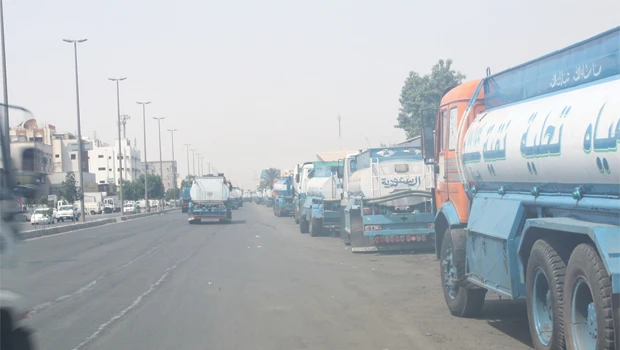
- JEDDAH: Since water supply has improved in most districts across Jeddah, residents have been left ecstatic and have been thanking city officials profusely.
- However, not everyone is happy.
Drivers of water trucks say that since the initiative began, their business and families have both dramatically suffered. “Our business is affected when the municipality began supplying the southeast area of Jeddah with continuous tap water,” said Ahmed Mohammed Zad, an Ethiopian driver.
He said it has been nearly a year since he had delivery orders continuously every day and was able to make enough money to take care of himself and his family. He is now lucky if he even gets one delivery a day.
Zad said he took a second job over the Ramadan and Eid holidays to take care of his family, adding that he still was not able to do well and was only able to afford the cheapest brands of food, clothing and toys for his children.
“I think it would be fair for the city to supply water two or three times a day and not every day, because this is not allowing people like us to earn a living. What are we drivers to do now?” Zad asked.
Mohammed Arshad, a Pakistani tanker driver, agreed saying that the Saudi truck owners are not the ones who suffer when there are shortages in deliveries.
“Owners purchase coupon books to sell water and we make the deliveries and get a percentage of the profits afterward. The owners don’t care if the amount of deliveries decreases because they don’t depend on this money the way we do,” he said.
Less than a year ago, water shortages caused the price of water trucks to range from SR114 to SR200.
The National Water Company (NWC) in a statement said that water supplies have been increased from 850,000 cubic meters per day to 950,000 cubic meters, and that it now supplies 60 percent of the city with an uninterrupted flow of water.
The NWC has said this has been made possible in cooperation with the Saline Water Conversion Corporation (SWCC) through the operation of the Al-Shuaiba desalination plant, which pumps 150,000 cubic meters of water per day to Jeddah.
Research carried out by the Ministry of Water has shown that on average each person in Saudi Arabia uses 286 liters of water per day, making the Kingdom the third largest per capita consumer of water after the United States and Canada.