
- As I am about to write this review, I remember Wilfred Thesiger's memorable prologue to "Arabian Sands" and these words in particular: "No man can live this life and emerge unchanged.
- He will carry, however faint, the imprint of the desert..." For this land, he continues, "can cast a spell which no temperate clime can match."
Twenty five years after she left Dhahran, Jean Grant still carries "the imprint of the desert."
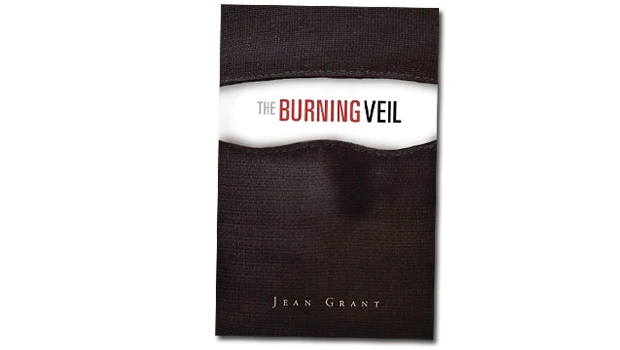
In her first novel based in Saudi Arabia, Grant neither distorts reality nor present an unflattering image of a country widely misunderstood to this day. This story of love between a young American doctor and a handsome Saudi engineer conveys with great accuracy the complex differences between two distinctive mentalities and their respective cultures.
Grant shows for example how Westerners are often upset by the restrained feelings showed by Muslims in the face of death. In the first pages of "The Burning Veil," Dr. Sarah Moss, (an American doctor who recently arrived in Saudi Arabia) loses a patient and she decides to discuss it over with the members of her medical team.
"It was a hard one, that death," she said, looking intently at each in turn. "Are you all right? Do you want to talk about it?
"To Allah we belong and to Him we return," Dr. Aziza said in a calm voice.
"It is very sad," Dr. Nadia added in a voice devoid of emotion. "God give us strength."
The American doctor is upset by the cool way her team reacts to the loss of life. She still ignores at that point how in times of difficulty or danger, Muslims quote verses from the Qur'an to bestow a strength and calmness that might be falsely mistaken for an absence of emotion.
Grant, who lived for 20 years in the Middle East, is familiar with Arab ways and customs. She spent 10 years in Dhahran with her husband, a professor of mathematics at King Fahd University of Petroleum and Minerals, until May 1986. Besides teaching, Jean worked as an Arab News staff reporter.
"I used to read Arab News every day," she recalls. "So I felt excited when my girlfriend Mary Jo McConahay, then the Eastern Province staff reporter for Arab News, told me that she was leaving and encouraged me to apply for her position. I almost didn't apply for the job because I worried that my lack of a journalism degree meant I wouldn't be considered."
McConahay went on to a most distinguished career, writing for Time, Newsweek, Vogue and The International Herald Tribune, encouraged Jean to apply. She was hired and went on to write on a variety of subjects.
"In those early days of Arab News, everything was informal," says Jean, who filed her stories by fax from an office in downtown Alkhobar. She also wrote for Saudi Business, an Arab News sister publication."
At the time, there was no local staff photographer, so Jean provided most of the photographs to accompany the articles with the help of her son who transformed a bathroom into a darkroom. (For this reason she would often send her articles and photos by express package delivery.)
Contrarily to what people might think, Jean found her job "surprisingly easy". Although she conducted many interviews by telephone, she managed to get around. At the time, women were discouraged from taking taxis so she counted on her husband to drive her around to perform her duties.
Grant very soon realizes that unlike her male colleagues who encountered difficulties in talking to Saudi women, she had the advantage of being able to interview easily both men and women — except on one occasion.
"I was sent at the last moment to Riyadh to interview the late Indira Gandhi," she recounts. "I had always admired her, so I waited and waited the whole day long on tenterhooks, but for naught. The royal-protocol officials would not explain why the interview had been canceled. I felt very embarrassed calling my editor from the royal palace and explaining what had happened. What I regret in hindsight is that I didn't have the presence of mind to request an interview with her son, Rajiv Gandhi, who became president upon her death and remained so until 1989."
Jean also recalls the wonderful meeting she had with Saudi Labor Minister Ghazi Al-Gosaibi, the poet, minister and former ambassador who passed away Aug. 15 at 70. Jean also interviewed several Saudi Cabinet ministers, US senators visiting the Kingdom, and even Apollo astronaut Jim Lovell, the man Tom Hanks plays in the 1995 film "Apollo 13."
Despite the interviews with these prestigious sources, Jean admits that her best moments were her stories covering artists, educators, date-palm growers and nannies.
"Perhaps for every reporter, the first few stories are really thrilling ones. It felt terrifically exciting to see my byline those first few months," she says. "One of my earliest features was on the Thursday camel market in Hufuf. If I hadn't been there as a reporter, I would still have enjoyed the outing, but I wouldn't have had the marvelous excuse to be with the camel merchants and bystanders. Being a reporter made me much more aware of my surroundings and made me experience them more deeply."
Jean acknowledges that she still remembers warm nights, starry skies, and the unique variety of fascinating people. She admits that she started and stopped working on her novel many times between the year she left Saudi Arabia in 1986 and now.
"I'm not sure why it took me so long," she says. "Perhaps because I had so much of myself invested in it and I wanted it to be both truthful and positive. Writing the novel gave me a chance to relive my years there through imagination and memory."
The Burning Veil is a work of fiction. Although no character is based on a real person, Sarah, the novel's main character is similar to the author, especially in her reactions and feelings as an expatriate.
Jane was not able to return to the Kingdom during the time period of the novel, but she incorporated news events that occurred since her departure. After reading about the tragic fire that killed 15 teens at a girls school in Makkah in 2002 — which led to allegations (that were officially denied) the religious police played a role in hindering rescue efforts — she features this incident in the novel by changing its location to the Eastern Province.
Before settling for "The Burning Veil" as the novel's title, Grant considered the title "Blind Cats," referring to the slang for women as weak and soft creatures that need to be pampered.
"In hindsight, that might have been a better title, for I object to that view of womanhood," she says. "I do not object to the veil, but I do think it should be a woman's decision whether or not to wear it."
Jean splits her time between the central US city of Lawrence, Kansas and southern France. She says she was upset by the July 13 decision of the French Parliament, comprised mainly of men, to ban the face veil (niqab). She also praises Sheikh Aed Al-Qarni for what she calls his wisdom in advising French-Muslim women facing harassment for wearing the niqab to go ahead and uncover their faces because "his tolerant view speaks to the important point that God is a God of love who does not wish suffering in his name."
"The Burning Veil" reflects the author's deep feelings for the Kingdom. This novel is a remarkable journey in a fascinating but little known country. The reader gets a real taste of family life in Saudi Arabia. At a time when people are becoming less tolerant, "The Burning Veil" offers a healing message of love and hope.
"I hope my novel will help increase understanding between east and west, Muslim and Christians," says Jean.
What does she miss most about Saudi Arabia? Hearing the adhan (the muezzin's call to prayer).
"I especially loved the dawn call, such a marvelous way to begin the day to hear that lifting call. Although I am not a Muslim, the adhan centered my life and gave it focus reminding me of the beliefs of Islam, that it is a religion of beauty."