- ON the occasion of the 61st anniversary of the founding of the People’s Republic of China, I would like to extend, on behalf of the staff of the Chinese Embassy and myself, warm congratulations and sincere greetings to all the Chinese who are studying and working in the Kingdom of Saudi Arabia.
- It also coincides with the 20th anniversary of the establishment of diplomatic relations between PRC and KSA.
Over the past 61 years, China has made remarkable achievements in its domestic development and external relations. Chinese economy has achieved a historic leap. In the first six months of this year, China’s total trade volume reached $1,354.8 billion and its foreign exchange reserves reached $2,400 billion, ranking third and first respectively in the world. The educational system improves continuously. Free and compulsory education in urban and rural areas is fully realized, the number of students enrolled in universities, high schools and elementary schools ranked first in the world, and China now issues more Ph.D. than any other country in the world. A social security system covering both the urban and rural areas has taken initial shape. Public medical service continues to improve, providing health care for more than 1.2 billion residents in urban and rural areas. The 2010 World Expo currently being held in Shanghai is presenting a harmonious, inclusive, prosperous and progressive China.
China pursues an independent foreign policy of peace and has established diplomatic ties with more than 170 countries on the basis of five principles of peaceful coexistence. China actively engages in multilateral issues, shoulders its due share of international responsibilities. It has joined more than 100 international organizations and is signatory of more than 300 international conventions. Out of the five permanent members of the UN Security Council, China contributes the most peacekeeping personnel. China is playing an increasingly important role in the international cooperation against global challenges, such as financial crisis, climate change, food security, public health security and terrorism.
However, we must be aware that China’s per-capital GDP still ranks below 100th in the world. According to the UN standard, China has more than 150 million people living in poverty. The imbalance of industrial structure and uneven development between urban and rural areas and among different regions remain a serious challenge. China is still a developing country and will remain so for a long time to come.
Just several days ago, Saudi Arabia celebrated its 80th National Day. In the past 80 years, the country has made huge progress in many areas. Especially in recent years, under the leadership of Custodian of the Two Holy Mosques King Abdullah, the country continues to enjoy social stability, and its people are living a happy life. Saudi Arabia has capitalized on its oil resources and carried out a large number of infrastructure projects, which has delivered greater welfare to the people and driven the economy into a new period of prosperity. Saudi economy has successfully weathered the impact of the international financial crisis and maintained a steady growth. The educational system is also making headways. Most impressively, with the implementation of the Ninth Five-Year Development Plan, Saudi Arabia had announced its First Five-Year Plan for Science Innovation, which will undoubtedly give great impetus to its national development and prosperity. Saudi Arabia is highly commended by the international community for its active role in safeguarding peace and stability in the Middle East, pursuing the proper settlement of relevant issues and vigorously advocating for transnational and inter-cultural dialogue. All this has greatly elevated its international status and influence. We believe that under the able leadership of King Abdullah, Saudi Arabia will embrace a brighter future.
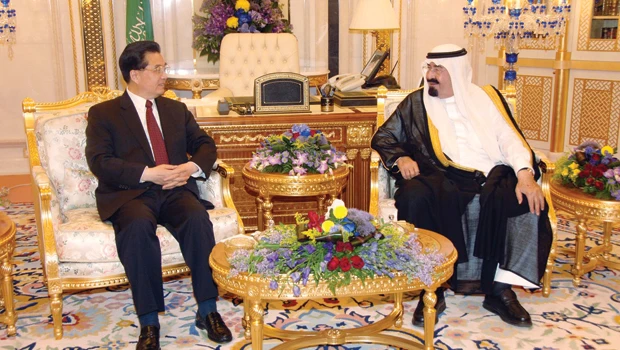
The Sino-Saudi relations can be regarded as a model of the friendly cooperative relations between China and Arab states. Since the establishment of diplomatic relations 20 years ago, the Sino-Saudi strategic friendly relations has developed rapidly. We have seen frequent high-level exchanges with growing mutual political trust. King Abdullah visited China in 1998 as the crown prince and in 2006 again during his first overseas visit after his accession as king. President Hu Jintao visited Saudi Arabia in 2006 and 2009 respectively. Chinese Vice President Xi Jinping visited Saudi Arabia in June 2008. In 2010, Yang Jiechi, Chinese foreign minister, and Chen Deming, minister of commerce of China, visited Saudi Arabia respectively. In May, Prince Saud Al-Faisal, Saudi Arabian foreign minister, visited China and attended the Fourth Ministerial Meeting of the China-Arab Cooperation Forum. This year the leaders of the two countries also exchanged congratulatory messages on the 20th anniversary of diplomatic ties.
Saudi Arabia has remained the largest trading partner of China in West Asia and Africa for nine consecutive years. The bilateral trade volume reached $32.6 billion in 2009, and $16.32 billion from January to May in 2010, registering a year-on-year increase of 59.5 percent. China imported 41.95 million tons of crude oil from Saudi Arabia in 2009, it’s expected to surpass 50 million tons this year. Bilateral cooperation in energy, telecommunication, investment, infrastructure construction has been unfolding with satisfactory results. Our two countries are also working more closely on education, youth, culture, sports and information. This July, the Cultural Week of Saudi Arabia was held by the Saudi side in China. The Saudi youth delegation led by Dr. Sa’doun, undersecretary for economic and cultural affairs of the Saudi Foreign Ministry, are now visiting China and interacting with the young Chinese under the framework of China-Saudi Youth Forum.
At present, both China and Saudi Arabia are at the best stage of development, and the bilateral relations are at its best time in history. We believe that with the joint efforts from both sides, the Sino-Saudi strategic friendly relations will move forward to a higher level and therefore bring greater benefits to the people of our two countries.
Yang Honglin
Chinese Ambassador to Saudi Arabia