- A massive support package to help Xinjiang achieve leapfrog-like development was unveiled at a central work conference on the region’s development — the first of its kind in 60 years — held in Beijing on May 17-19.
At the conference Chinese President Hu Jintao said that Xinjiang’s development is a necessity to improve people’s living standards and realize a moderately prosperous society in the region. Developing Xinjiang is also a strategic choice to deepen the Western Development Strategy and tap new sources of economic growth.
Despite Xinjiang’s rapid development in recent years, it has failed to keep up with the rest of the country and has even fallen behind other provinces and regions in west China. In 2009, Xinjiang’s Gross Domestic Product (GDP) grew 8.1 percent year on year, but still lower than the country’s average which was 8.7 percent. But most central and western provinces or regions saw double-digit growth last year, propelled by the country’s 4-trillion-yuan ($586-billion) stimulus package. Meanwhile, Xinjiang’s per-capita GDP was only $2,917 last year, compared with the country’s average of $3,679. Its urban and rural residents’ per-capita annual incomes were also lower than the national level.
These gaps are expected to be gradually bridged. At the conference, Hu set several goals for Xinjiang to achieve in the next five to 10 years. Chinese Premier Wen Jiabao also proposed a series of preferential policies to boost Xinjiang, among which was the resource tax reform launched on June 1.
The ambitious goals and the massive support package for Xinjiang have raised the curtain on a new round of development in the vast, less-developed northwestern region.
At the conference, Hu outlined the tasks Xinjiang should fulfill in the coming decade.
Hu said Xinjiang should push forward its economic, political, cultural and social development. By 2015, its per-capita GDP should catch up with the country’s average level and residents’ incomes and access to basic public services should reach the average level of China’s western regions.
Remarkable improvements should be achieved in Xinjiang’s infrastructure facilities, self-development ability, ethnic unity and social stability within five years. The end result, if hopes hold true, will be a moderately prosperous society in Xinjiang by 2020.
Specifically, focus should be first placed on propelling Xinjiang’s economic development. Its resource advantage should be transferred to actual economic strength. Industries with local advantages and local characteristics should be propped up. Agricultural production capacity should be increased. An innovative system should be set up and hi-tech industries should be promoted. Xinjiang’s tourism industry also deserves a boost. State investment should provide more support to transportation infrastructure facilities and give priority to infrastructure projects that directly benefit local people. Social development must also be promoted. More funds should be invested in public service sectors and major public welfare projects. Public services should be improved. All levels of education should be developed. A social security system and a social assistance system should be built. Establishment of a new rural pension system should be accelerated. By 2012, a basic medical and public health system, covering both urban and rural residents, should be set up.
The eco-environment and people’s living environment should both be improved. The circular economy should be developed, and Xinjiang will be encouraged to cooperate with other regions to open up to the outside world. This will be facilitated through a partner assistance program between relatively developed regions and Xinjiang.
People’s living standards should be raised. Assistance funding from the central government and partnering regions, and revenue increased from the resource tax reform will mostly be used to improve people’s living and production conditions. And resource exploitation should more directly benefit local people. More jobs should be created, more efforts should be taken to alleviate poverty and absolute poverty should be eliminated by 2020. Public services will be improved and local people’s cultural life will be enriched.
To meet these objectives, Wen said the central government decided to launch a series of support policies for Xinjiang to accelerate the region’s economic and social development. The policies include:
1. A pilot reform on resource tax will start in Xinjiang, with crude oil and natural gas being taxed by price rather than volume.
2. Qualified enterprises in impoverished areas will be exempted from paying income taxes for two years and be allowed a 50-percent reduction for another three years.
3. Xinjiang will enjoy preference in receiving central government investment. Fixed assets investment in the region over the next five years (2011-15) wills double that of the previous five years.
4. Commercial banks will be encouraged to open outlets in remote areas. Joint equity commercial banks and foreign banks will be invited to set up branches in Xinjiang.
5. Additional undeveloped land will be approved for construction.
6. Access requirements to industries related to resources or with high market demand will be relaxed.
7. The scale of natural gas consumption in Xinjiang will also be expanded.
Wen also made specific arrangements for improving Xinjiang’s social and economic work.
Social development with an emphasis on improving people’s well being should be promoted. Poverty-stricken areas should be specially supported. Infrastructure construction should be strengthened and the eco-environment should also be improved. Industries with local advantages and local characteristics should be vigorously developed. Xinjiang should be further opened up, both to other parts of the country and to foreign countries.
In line with the central work conference, Xinjiang’s local authorities, related central government departments, and the regions participating in the partner assistance program have all committed to implement concrete measures and appropriate funds for assistance.
The Xinjiang local authorities will first launch a series of projects to improve people’s livelihood. As part of that plan, Xinjiang will try to transform the shantytowns in cities and state-owned mine areas in five years into ordinary houses.
Housing projects for rural residents and herdsmen will be finished by 2015 and 2020, respectively.
In the next five years, all urban residents will be supplied with natural gas. Rural areas will also have access to natural gas. And the prices of power and gas supply for both urban and rural residents will be lowered.
With regard to employment, the government will provide unemployed college graduates with a temporary monthly minimum allowance and in the same time, language and vocational training to help them find jobs. To jobless families, jobs in the public service sectors can be provided within three months. Beginning this year, a new rural pension system will be launched in poor areas and expanded throughout the region by 2012. A basic medical and public health system will also be established that year.
Construction of three water reservoirs in south Xinjiang will improve flood resistance and farmland irrigation, and alleviate power shortages in the region.
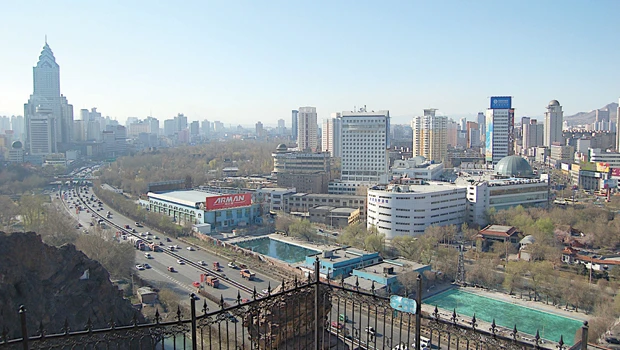
In an effort to improve urban residents’ living environment, heavy air pollution in Urumqi, capital of Xinjiang, will be mitigated within five years.
Meanwhile, several ministries have already announced their plans.
Central Bank Gov. Zhou Xiaochuan said the central bank will promote renminbi settlement in cross-border trade and investment, which can play a role in propelling Xinjiang’s economic growth. The central bank will also help small and medium-sized enterprises in the region, he said.
The Ministry of Transport will raise the ratio of subsidies to investment in Xinjiang’s major highway projects from 20 percent to 50 percent over the next five years. Li Shenglin, Minister of Transport, said 38 percent of highway investment in Xinjiang will come from the central government’s direct subsidies and Xinjiang’s highway projects can apply for bank loans without local government’s contributed capital.
The State Grid Corp. of China also announced an investment of 4.17 billion yuan ($611 million) in Xinjiang from 2011 to 2015 to provide a power supply to areas with no access to electricity.