
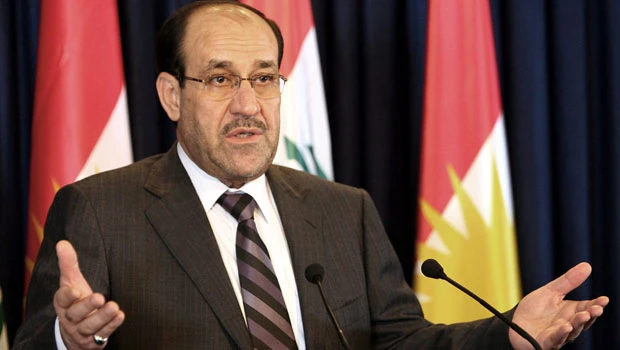
- BAGHDAD: Attempts by Nuri Al-Maliki to form a new government could be weeks, if not months, away from fruition because the prime minister is struggling to secure support from Kurdish and Sunni factions.
Maliki was picked on Friday as the nominee for the top government job from his Shiite-led National Alliance after he secured support from Moqtada Al-Sadr, an anti-American Shiite cleric whose militia once fought against US troops in Iraq.
But the Sunni-backed Iraqiya bloc is threatening to boycott a Maliki government at a time when Iraq is struggling to tame insurgent violence.
“Iraqi government formation has entered a new, dark tunnel, and into new complexities,” said Khamis Al-Badri, a professor of political science at Baghdad University.
Nearly seven months after an inconclusive parliamentary election, the absence of a functioning government is a worry for the United States, which is keen to present the world with a stable Iraq after ending combat operations there in August.
Military leaders say insurgents are trying to take advantage of the power vacuum more than seven years after a US-led invasion that ousted Sunni dictator Saddam Hussein.
Washington says it has no preferred candidate but it regards the emergence of the Sadrists, viewed as close to Iran, at the center of Iraq’s political map as an unwelcome development.
Maliki’s nomination is no guarantee that he would succeed in convincing others to work with him to form Iraq’s new government, particularly because dissenters within his own Shiite alliance appear ready to bolt.
Maliki must find a way to win support from the Kurds, who seek greater influence for their semi-autonomous northern region over the oil-rich Kirkuk region in return for their allegiance.
He also needs to woo Iraqiya, the alliance headed by former Prime Minister Iyad Allawi which won 91 seats at the election in March, to bring minority Sunnis into the fold and mend fences with Shiite dissenters.
With clear support from his State of Law bloc, which holds 89 seats, and the Sadrists, with about 39, Maliki remains dozens of seats short of the 163 needed for a governing majority.
The support of the Kurdish alliance, with around 56 seats, would help tilt the balance. The Kurds say they would join any government as long as most of their demands were met.
“We have demands, we have presented our demands to others. Whether it is Maliki or someone else, whoever is able to strike a deal with us on our demands, we will cooperate with him in forming a government,” said Mahmoud Othman, a Kurdish lawmaker.
Maliki must also deal with a rift that has alienated key elements of the alliance, including the Supreme Islamic Iraqi Council and its former armed wing, the Badr Organization.
“We in ISCI and Badr say we don’t support the nomination of Maliki for a new term,” said Aziz Al-Ugaili, a Badr lawmaker. “If we do, this means we are supporting a failed government.”
Yet, in a glimpse into Iraq’s often opaque political decision-making, Hadi Al-Amiri, head of Badr, was seen standing next to other politicians from the Shiite alliance when Maliki’s nomination was announced at a new conference on Friday.
Allawi has said that excluding his coalition could anger Sunnis who were marginalized after the Shiite majority supplanted them following the 2003 invasion.
If he were able to win the Kurds over, Maliki would be in a stronger negotiating position, which could pressure Iraqiya to change its position and join the government.
Gala Riani, an analyst with IHS Global Insight, said: “It is difficult to see Iraqiya joining a Shi’a-led government with Maliki at its helm, unless it is provided with significant concessions.”