
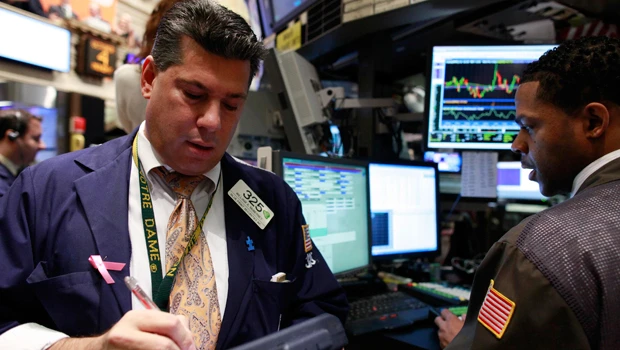
- NEW YORK: The US dollar gained broadly on Monday on lingering concerns growth could be weaker in euro-zone economies, while speculation of further monetary easing by the US Federal Reserve boosted Treasuries prices.
US and European stocks fell on fears that tighter banking capital rules imposed by Swiss policy makers may cut the profitability of the financial sector.
Worries about euro zone economies were again in the spotlight, adding pressure to the euro, after the Irish central bank said Ireland's economy will crawl to a virtual halt this year, defying government hopes of a modest growth.
Investors were also cautious about the implementation of additional austerity measures in Portugal.
"The euro has come a very long way in a very short period of time, and certainly Ireland and the peripheral euro zone country issues have not gone away," said Omer Esiner, chief market analyst at Commonwealth Foreign Exchange Inc. in Washington. When those issues "come back in the spotlight, they are used to take some profits on the euro."
The European single currency weakened 0.73 percent against the dollar to $1.3688.
Euro-zone concerns also bolstered the dollar against other major currencies. The US Dollar index rose 0.45 percent despite expectations of additional monetary easing by the Fed, which tends to be negative for the greenback.
Against the Japanese yen, the dollar was up 0.23 percent at 83.38.
Gold prices retreated slightly as the dollar rose. Spot prices for the metal fell 0.22 percent to $1,314.40 an ounce, close to Friday's all-time high of $1,320.80.
Gold prices have been soaring recently as investors see it as a safe-haven alternative to a weakening dollar.
"Gold is holding up comparatively well considering the rebound in the US dollar," said David Thutell, an analyst at Citigroup. "I suspect that for many months there will be enough market participants who don't buy the recovery story and will keep buying gold."
Speculation that the Fed will eventually resume quantitative easing to support the economy, probably by purchasing more government bonds, sent yields on two-year Treasury notes to a record low of 0.4 percent in overnight trading.
The two-year notes were up 1/32 in price later, with the yield at 0.4106 percent. Prices of 30-year bonds rose 3/32, sending their yield down to 3.7129 percent.
Key stock indexes slid in the United States and Europe following a decision by Swiss regulators to require global banks UBS AG and Credit Suisse to hold far more capital than their international rivals.
The rules, aimed at preventing a banking crisis in Switzerland, could crimp competitiveness in investment banking.
"These austerity measures are necessary but don't have a stimulating effect on the market," said Malcolm Polley, president and chief investment officer of Stewart Capital Advisors in Indiana, Pennsylvania. "It could mean that equity returns will be muted, though not necessarily down, for quite a while."
The MSCI All-Country World stock index fell 0.7 percent, while Europe's FTSEurofirst 300 index fell 0.63 percent in its sixth straight session of losses.
The thee main US stocks indexes posted losses of about 1 percent by midday.
The Dow Jones Industrial Average declined 112.62 points, or 1.04 percent, to 10,717.06, while the Standard & Poor's 500 Index fell 13.76 points, or 1.20 percent, to 1,132.48. The Nasdaq Composite Index was down 36.74 points, or 1.55 percent, at 2,334.01.
Microsoft Corp. shares weighed on the market, falling more than 2 percent after Goldman Sachs downgraded the stock to "neutral," citing competition from tablet computers.
Key emerging market stock indexes remained in positive territory, however, as investors continued to favor fast-growing developing economies. The MSCI index for emerging market shares gained 0.29 percent.
Oil prices were little changed after a rally of more than 6 percent last week. US crude prices gained 0.15 percent, to $81.70 per barrel.