
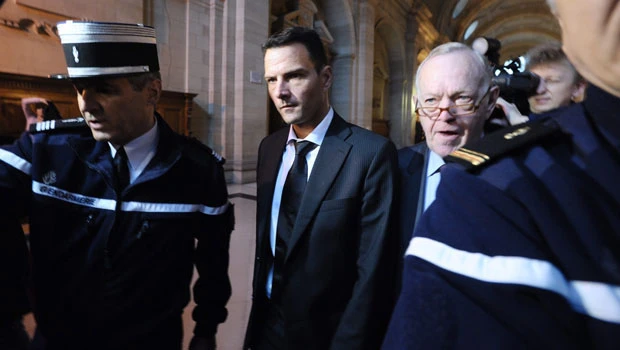
- PARIS: Ex-trader Jerome Kerviel was convicted on all counts Tuesday in history's biggest rogue trading scandal, sentenced to at least three years in prison and ordered to pay his former employer damages of 4.9 billion euros ($6.7 billion) — a sum so staggering it drew gasps in the courtroom.
The court rejected defense arguments that the 33-year-old trader was a scapegoat for a financial system gone haywire with greed and the pursuit of profit at any cost — a decision sure to take some pressure off the beleaguered banking system overall.
By ordering a tough sentence for a lone trader, the ruling marked a startling departure from the general atmosphere of hostility and suspicion about big banks in an era of financial turmoil. It was a huge victory for Kerviel's former employer Societe Generale SA, France's second-biggest bank, which long had a reputation for cutting-edge financial engineering and has put in place tougher risk controls since the scandal broke in 2008.
Kerviel maintained that the bank and his bosses tolerated his massive risk-taking as long as it made money — a claim the bank strongly denied.
"I have the feeling Jerome Kerviel is paying for an entire system," said Olivier Metzner, Kerviel's lawyer, noting that his client hadn't benefited financially from the fraud.
Kerviel stood expressionless as the court convicted him and pronounced a five-year sentence with two years suspended. Kerviel was found guilty on charges of forgery, breach of trust and unauthorized computer use for covering up bets worth nearly 50 billion euros between late 2007 and early 2008. He was also banned for life from working in the financial industry.
In the most stunning blow, the court ordered Kerviel to pay the bank back the ¤4.9 billion that it lost unwinding his complex positions in January 2008 — a punishment nobody realistically expects him to repay.
It's the equivalent of 20 Airbus A380 superjumbo jets, or the entire gross domestic product of the west African nation of Benin.
French media calculated that — based on his current salary of 2,300 euros ($3,150) a month as a computer consultant — it would take Kerviel 177,536 years to pay off the damages.
The sentence "is more symbolic than real" said Bradley Simon, a white collar criminal defense attorney, "because he will never be able to pay even a tiny fraction" of the amount.
Simon, a New York-based former federal prosecutor turned white-collar criminal defense attorney, said the decision was "breathtaking." "One low-level individual must bear the total responsibility for the near-demise of a pillar of the French financial system," Simon said. "This judgment ignores what we now know to be the real case, that Societe Generale and financial institutions throughout the world were encouraging risky trades." Kerviel's lawyer said he would appeal and will remain free pending that appeal. The damages are also suspended during the appeals process.
Paris lawyer Emmanuelle Kneuse, who works on white-collar crime cases, said the damages were the largest she could recall in France.
If the prison sentence and huge damages are maintained on appeal, that would likely force Kerviel to promise substantial monthly payments to secure his release on parole, she said.
Societe Generale spokeswoman Caroline Guillaumin called the verdict "an important ruling that acknowledges the moral and financial harm done to the bank and its staff." "The bank can now turn the page, pursue its strategy and continue to rebound," Guillaumin said in an e-mailed statement.
Kerviel sat with his arms folded and his legs crossed during the first 45 minutes of the hour-long hearing, alone in the front row of the courtroom. He barely blinked as each guilty verdict was read out. He then stood for sentencing in a dark suit and tie, frowning and silent.