
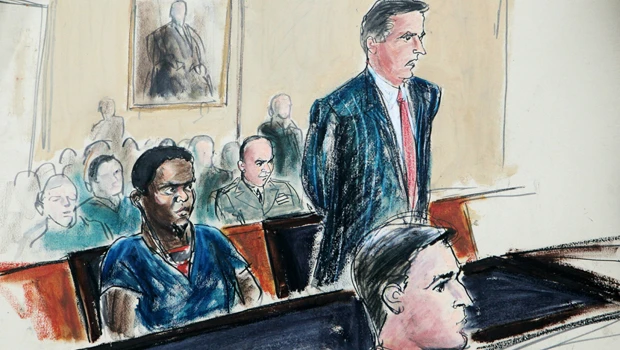
- NEW YORK: A US judge refused on Wednesday to let a key witness testify in the first criminal trial of a terrorism suspect from the Guantanamo Bay military prison, a setback for the Obama administration’s effort to prosecute such cases.
The trial of Ahmed Khalfan Ghailani at Manhattan federal court was delayed until next Tuesday to give prosecutors time to review the ruling and decide on an appeal.
Ghailani, 36, is a Tanzanian charged with conspiring with Islamic militants to bomb the US embassies in Tanzania and Kenya in 1998, in which 224 people were killed. He faces life in prison if convicted.
Ghailani’s trial is being watched closely as a test of President Barack Obama’s approach to handling the 174 suspected terrorists held at Guantanamo Bay, Cuba, including Khalid Sheikh Mohammed, accused mastermind of the Sept. 11 attacks.
Obama’s administration has adopted what it calls a flexible approach, favoring military tribunals in some cases and civilian trials in others. Most Republicans say all terrorism suspects should be tried in military tribunals.
US Attorney General Eric Holder defended the option to use civilian criminal courts.
“History has shown us over 300 times that in fact we can do that either by pleas (or) by trials and I think it’s too early to say that at this point (that) the Ghailani matter is not going to be successful,” he told a news conference in Washington.
“We intend to proceed with this trial,” Holder said.
Prosecutors had wanted the court to hear testimony from Tanzanian witness Hussein Abebe, who they say told FBI agents he had sold explosives to Ghailani that were used later in one of the bombings. Defense attorneys say Ghailani had no idea what the equipment was going to be used for.
Senator Jeff Sessions, the senior Republican on the Senate Judiciary Committee, warned that rulings like the one on Wednesday would be frequent if the Obama administration proceeded with criminal prosecutions for terrorism suspects instead of military trials. He urged Holder to change course.
“The blame for this setback is properly directed at the president and the attorney general who have — contrary to all law, logic, and the will of the people — insisted on trying these unlawful enemy combatants in civilian criminal court,” he said.
“Trials in military courts are fair, yet they do not have to comply with the rules of criminal justice that were never designed for the battlefield,” Sessions said.
In an initial, terse three-page order, District Judge Lewis Kaplan said he would not allow Abebe to testify and that he would issue a complete opinion later on Wednesday. He said his decision was based on protecting the US Constitution from admitting coerced testimony into civilian courts.
Peter Quijano, a lawyer for Ghailani, said the Constitution “won a great victory.” “This case will be tried upon lawfully obtained evidence only. Not coercion. Not torture,” he said.
From the outset, prosecutors said they would not use any statements Ghailani may have made while in CIA custody after his July 2004 arrest in Pakistan. Prosecutors have acknowledged those statements were likely “coerced.”
But the judge said the government would not have been able to find Abebe without those statements. “Abebe was identified and located as a close and direct result of statements made by Ghailani while he was held by the CIA,” Kaplan said.
The government had not proven that “the connection between Ghailani’s coerced statements and Abebe’s testimony is sufficiently remote or attenuated,” Kaplan said.
Ghailani, who was arrested as an enemy combatant, was transferred to the prison at the US Navy base at Guantanamo Bay in September 2006.
Obama has vowed to close the prison amid international condemnation of the treatment of detainees, but has run into political resistance at home to the move, including in US states where the prisoners would be moved.
A spokeswoman for the US attorney’s office declined to comment on Kaplan’s order in the Ghailani case.
At a hearing last week, Assistant US Attorney Michael Farbiarz, who is prosecuting the case, told the judge that Abebe was essential because he alone could tell a jury that Ghailani purchased the explosives with full knowledge and intent.
“Indeed without Abebe, the government has no way of putting such evidence in front of the jury at all,” Farbiarz said.
Prosecutors say Ghailani also bought a truck and oxygen tanks used in the attack. They say he took a flight to Pakistan with other Al-Qaeda operatives shortly before the bombing.

