
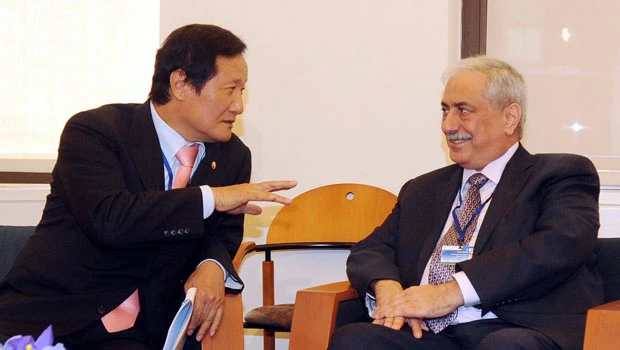
- WASHINGTON: World finance leaders sought on Friday to tamp down simmering currency tensions that threaten to drag on an economic recovery that is already too slow and uneven for their liking.
Group of 20 finance ministers met at a breakfast on the sidelines of this weekend's International Monetary Fund and World Bank twice-yearly meetings and some said an effort was under way to come to grips with simmering tensions.
Canadian Finance Minister Jim Flaherty told reporters as he arrived for the meeting that it was vital G20 countries not engage in protectionist measures as a response to currency strains but he also singled out China, saying it must live up to a commitment to allow more currency flexibility.
He expressed hope finance ministers meeting in Washington over the weekend could find a way through the thorny thicket of currency tensions that has raised fears of a global round of competitive devaluations.
"I would expect that we'd arrive at a consensus with respect to the necessary direction," he said.
The smaller group of rich G7 advanced economies was set to hold a closed-door dinner later Friday at which currencies were also expected to be discussed.
China's policy of managing the value of its yuan has raised the hackles of trade partners who consider it unfairly undervalued and who charge it permits China to rack up huge surpluses at others' expense.
The yuan ended at its highest closing level on Friday since a landmark revaluation in July 2005, possibly a sign that Beijing is sensitive to the growing demands to let it rise more rapidly.
At the same time, expectations the US Federal Reserve will further ease monetary policy — bolstered by a report showing the US economy lost 95,000 jobs last month — has pushed the dollar down to an 8-1/2 month low against a broad basket of currencies.
The dollar's drop has led investors to chase bigger returns in emerging markets such as Brazil, driving up asset prices and inflation.
Olli Rehn, the European Union's economic and monetary affairs commissioner, said currencies were on the table but in the broader context of trying to rebalance global growth to make it more durable.
"We are discussing what kind of policy measures are needed to rebalance global growth and the currency issue is certainly one of those," Rehn told reporters.
But the currency issue is complicated. Some countries, including Japan, have made clear they reserve the right to intervene to curb their currencies' values if necessary.
"We are approaching a G7 meeting, but regardless of this, Japan will take firm measures, including intervention, when needed," Japanese Finance Minister Yoshihiko Noda said.
China, usually at the center of the currency debate, has company this time, but Japan's intervention last month to weaken the yen put Tokyo on the hot seat, too.
The United States can also expect criticism over its seemingly benign neglect of the sinking dollar.
"What we all want is a rebalancing of the global economy and this rebalancing cannot happen without ... a change in the related value of currencies," IMF Managing Director Dominique Strauss-Kahn said on Thursday.
The currency strains are symptomatic of a deeper problem: Most advanced economies are not growing rapidly enough to reduce unemployment despite trillions of dollars in government stimulus spending and emergency loan guarantees.
For the United States and much of Europe, options for providing more stimulus are limited because either politics, creditors or both prevent them from amassing significantly larger piles of government debt.
Until rich nations find their footing, emerging markets will be the strongest source of global growth. So far, they appear to be up to the task. The IMF expects emerging markets to grow at three times the pace of advanced economies next year.
Those countries are clamoring for greater decision-making power at the IMF, commensurate with their growing economic prowess. This has been another thorny issue for G7 and G20 leaders who have yet to agree on how exactly to divvy up power when no one wants to relinquish their own position.
The United States thinks Europe ought to give up some if its seats on the IMF executive board, while European countries have proposed a seat-sharing rotation.
IMF officials were scheduled to attend Friday's G20 breakfast, and were hopeful that some progress can be made toward resolving reform issues by a G20 leaders summit in Seoul next month.