
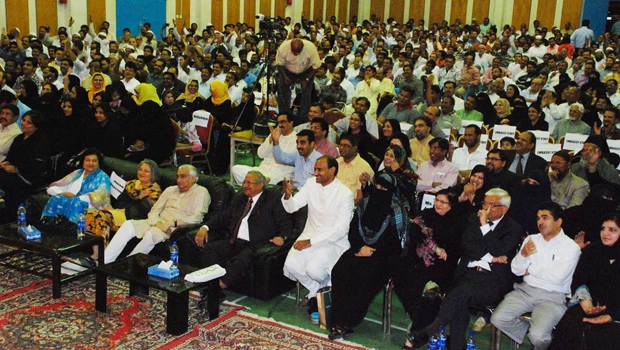
- RIYADH: Urdu poetry lovers in the capital were treated to some of the finest fare on Thursday evening.
- The star attraction at the mushaira organized by the Indian Embassy was of course Professor Shaharyar who was named last week as the recipient of India's most prestigious Gyanpeeth Award.
Besides Shaharyar other poets, known in the Urdu world as creative geniuses, such as Waseem Barelvi, Abdul Ahad Saaz, Meraj Faizabadi, Nadeem Siddiqui, Habib Hashmi, Raoof Khair, Anwar Jalalpuri, Nusrat Mehdi and Fayyaz Farooqui took part in the poetry gathering at the International Indian School Girls section's auditorium.
Indian Ambassador Talmiz Ahmad called Urdu the language of love and bonding. "Urdu belongs to everybody and its future is very, very bright in India," he said amid thunderous applause. Dr. Hifzur Rahman came in for special praise from the ambassador for the selection of poets and meticulous arrangements.
Shaharyar, the 54-year-old literary award recipient, declared that he is still active as he was in his prime. Talking about the pain of migration, he said: Mujhe is dasht mein sab kuch mayassar hai magar phir bhi, koi awaz hai jo roz ghar jaane ko kahti hai." He expressed the same feeling in another couplet: Kaisi majboori wo laacahari hai is kooche mein, jaa nahi sakta magar jaane ko jee chahta hai.
His couplets on the pain of life were well received when he said: "Baarha poochna chaha kabhi himmat na hui, dosto raas tumhe aaye ye duniya kaise, zindagi mein ek pal hi sahi ghaur karo, khatm ho jaata hai jeene ka tamasha kaise."
Professor Waseem Barelvi presented couplets on various issues; his work on the dilemma of expatriates was well received when he said: "Apni mitti ko zara peeth jo dikhlai hai, dar ba dar kaisi bhatakne ki saza paaye hai." On the plight of parental relationships, he said: "Ek bigdi hui aulad bhala kya jaane, kaise maan baap ke hoton se hansi jaati hai."
As the Ayodhya verdict was pronounced the same afternoon, it was a topic that was dealt by the poets. Meraj Faizabadi reacted to the judgment in his own style and said: "Ajeeb hai faisla tumhara, na koi jeeta na koi haara." Upon the appeal of politicians to maintain peace in India, Meraj said: "Khareeb aane ki koshish to main karoon lekin, hamare beech koi faasla to dikhai de."
Fayaz Farooqi, an IPS officer from Punjab, rendered several verses on the culture of corruption and other real life problems. Specially, "Ghar jo bharna ho to rishwat se bhi bhar jaata hai, haan magar is se duaon ka asar jaata hai."
Senior poet from Mumbai Abdul Ahad Saad said: Khud ko auraun ka tamasha na karo, aina dekhlo ahbab se poocha na karo, aagahi qaid nahi chand kutub khanon meiin, rah chalet hue logon se bhi yarana karo.
Rauf Khair commented on current affairs: "Jo la makan hai ise hi nikalna hoga, ayodhya se bhala ram kaise niklega, giraftari ke sab harbe shikari leke nikla hai, parinda bhi shikari ki supari le ke nikla hai."
The event's anchor, Anwar Jalalpuri, highlighted the sentiments of expatriates by reciting: Pardes mein tum khush the magar ye to batao, ghar laut ke aaye ho to ghar kaisa laga.
Senior poet Habeeb Hashmi rendered lines on realities of life. "Hairat hai kisi haath mein pathar bhi nahi hai, aur shahr mein mahfooz koi sar nahi hai."
Couplets of the journalist and poet Nadeem Siddiqi were about fate and luck: "Use uski kismat ne khoka diya, jo kismat ko sab kuch samajhta raha, likha hi nahi tha jo taqdeer mein, badi der tak who bhi padhta raha."
Nusrat Zaheer from Delhi depicted the real life experience in "kahan pe kab kise hamrah le ke chalna hai, kabhi kabhi yue hunar umr bhar nahi aata."
Nusrat Mehdi regaled the audience and topped it with this effort, "dhoop ne sataya to saibaanki yaad ayee, har ghadi buzurgaon ke astane ki yaad aayee."
Poetess Deepti Mishra from Mumbai wowed with these couplets: "Wo ek dard jo mera bhi hai tumhara bhi, wahi saza hai magar hai wahi sahara bhi, diye jaate ho ye dhamki gaya to phir na aaonga, kahan se aaoge pahle meri dunia se jaao to."
Talmiz Ahmed lit the traditional candle at the beginning while Ambassador of Nepal Hamid Ansari also graced the mushaira. Rahman, press secretary, welcomed the gathering and introduced the poets.
This mushaira is important in the backdrop of the fact that this is the silver jubilee year of the first mushaira in Saudi Arabia that was held in 1985.