- JERUSALEM/AMMAN: Israeli Prime Minister Benjamin Netanyahu offered Monday to extend a moratorium on Jewish settlement construction in the West Bank, but only if the Palestinians meet his demand to recognize Israel as a Jewish state.
- The Palestinians swiftly rejected it.
Jordan meanwhile backed a European role in the Middle East peace process despite harsh Israeli criticism.
In a speech in the Knesset (parliament), Netanyahu said he would renew the settlement curbs if the Palestinians recognize the Jewish connection to Israel. "If the Palestinian leadership would say unequivocally to its people that it recognizes Israel as the national homeland of the Jewish people, I will be willing to convene my government and ask for an additional suspension," he said in a speech that was repeatedly interrupted by Arab lawmakers.
Netanyahu had made similar demands in the past, though he has never explicitly linked it to the settlement issue. On Sunday, Netanyahu's Cabinet passed a bill that would require non-Jewish immigrants to pledge allegiance to the "Jewish and democratic" state of Israel in order to receive citizenship.
The Palestinians refuse to accept Israel as a Jewish state, saying it discriminates against Israel's Arab minority and violates the rights of millions of Palestinian refugees scattered around the world. Instead, they say it is sufficient that they recognize Israel's right to exist.
Palestinian negotiator Saeb Erekat accused Netanyahu of "playing games" and said he saw no connection between Jewish settlements and Israel's national character.
"I don't see a relevance between his obligations under international law and him trying to define the nature of Israel," he said. "I hope he will stop playing these games and will start the peace process by stopping settlements."
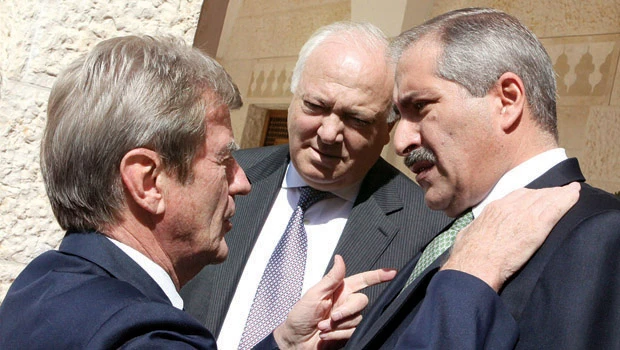
In Amman, French Foreign Minister Bernard Kouchner and his Spanish counterpart Miguel Angel Moratinos held separate meetings with King Abdallah and Palestinian President Mahmoud Abbas to try and break the deadlock over the direct talks between the Palestinians and Israel.
Abdallah told the European ministers that Jordan believed the European Union had "an important role to play in surmounting obstacles" facing the talks.
He urged Israel to stop building settlements. "Finding a convenient environment for resuming the Palestinian-Israeli negotiations requires the cessation of all unilateral measures, particularly the building of settlements," a royal court statement quoted the king as telling Moratinos and Kouchner.
The European ministers briefed the king on the outcome of their visit to Israel and the European Union's plan in support of the peace efforts.
They met in Jerusalem on Sunday with Netanyahu and Foreign Minister Avigdor Lieberman, who reportedly told them to try to resolve problems facing Europe before coming to the Middle East.
"If we didn't have a role, if we didn't have any weight, if we didn't have any influence, maybe our friend Lieberman wouldn't have reacted as he did," Moratinos told a news conference in Jerusalem before flying to Amman.
Separately, the Israeli government on Monday endorsed a bill requiring a national referendum be held before any withdrawal from occupied East Jerusalem or the Golan Heights.
"The inter-ministerial committee on legislation ratified a bill proposed by Likud MP Yaariv Levin about withdrawing from territories where Israel has sovereignty," a Justice Ministry spokesman said, referring to territories annexed by Israel after the 1967 Middle East war.
The committee gave the draft decisive approval, with seven votes in favor to three against.
— With input from agencies