- PARIS: France began to tap emergency fuel reserves at the start of a second week of action by refinery and port strikers as a growing number of petrol stations began to run dry on Monday.
The International Energy Agency (IEA), which overlooks strategic oil supplies in OECD countries, said France had some 98 days of oil stocks and that the country had started to draw on the industry’s 30-day emergency reserves.
Asked whether France had started to use its strategic industry reserves, Add Van Bohemen, the head of the emergency policy division told Reuters: “It’s already doing do.”
Nationwide strikes over pension reforms have spread to the country’s 12 oil refineries over the past seven days, adding to the impact of a three-week-long strike at France’s largest oil port, Fos-Lavera, over working conditions and a port reform.
On Monday, French truck drivers also staged go-slow operations on highways, and rail strikes intensified as protests gathered pace ahead of a Senate vote on the pension overhaul.
All but one of France’s 12 refineries had stopped production, and some refiners started to declare force majeure. Exxon Mobil, which operates two French refineries, said it was in the process of declaring force majeure on a number of French fuel supply contracts to supermarkets.
“These are contracts with big volumes,” the spokeswoman said.
On Oct. 12, refinery workers joined striking port workers at the southern oil port of Fos-Lavera, who downed tools three weeks ago.
Exxon Mobil declared force majeure on several French fuel supply contracts on Monday. On Friday, British chemical firm Ineos declared force majeure on one product from its refinery near Fos-Lavera, the first such action since the strikes began.
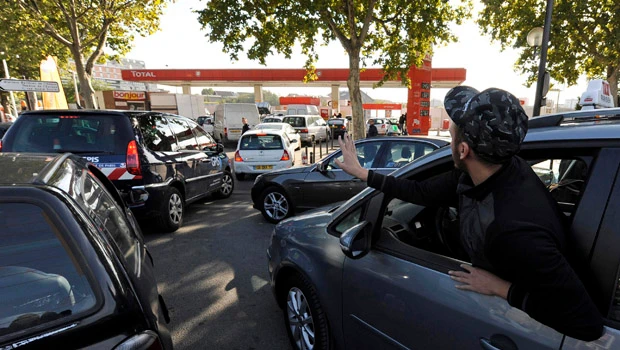
Motorists rushed to petrol pumps to fill up, but many were already closed or out of at least one oil product.
“It’s madness. We’re submerged,” said Paula, manager of a Champs Elysee service station.
According to a Reuters estimate, up to 1,800 petrol stations out of a total of 12,500 were hit by shortages. But this data must be treated with caution as the situation on the ground evolves very rapidly.
Many stations that were dry on Sunday had been filled up again by Monday and vice-versa.
The union of independent oil importers said between 500 and 1,000 petrol pumps they service at supermarkets were either running dry or had a shortage of one product. Supermarkets run 60 percent of French petrol pumps.
Exxon Mobil’s Fos-sur-Mer refinery in southern France was still operating at minimum output and was expected to do so until Oct. 21-22, a CFDT union official said, adding that fuel supplies were blocked.
“The situation is critical,” an Exxon Mobil spokeswoman said earlier. “Anyone looking for diesel in the Paris and Nantes (Western France) regions will have problems.”
The powerful CGT union, which represents most refinery and port workers, used the port strike as a lever for wider action against French President Nicolas Sarkozy’s pension reform.
The port workers at Marseille are among the most radical workers’ groups in France and have carried out repeated strikes over the past few years, which have dented the economic prospects of France’s largest oil port.
Unions called over the weekend for hardened protests, but the government said it would resort to force if necessary to prevent paralysis in the economy.
“When one sees the government’s tougher stance, it only reinforces the motivation of the troops,” one CGT union official for workers at Total’s refineries said. “As long as the government won’t budge, we won’t budge.”
Refinery and port strikers showed no sign of giving ground, with the prospect of the stoppages continuing at least until a new day of nationwide protests called by unions for Oct. 19.
Gasoline benchmark prices were lower on Monday at $765 a ton, down from $768-$777 a ton on Friday, according to traders.
“So far, no end to the problems is in sight,” JBC Energy said. “Still, the capacity reductions are a welcome boon for refiners elsewhere to cash in on the improved margins situation.”
Commerzbank commodities analysts wrote in a note to clients that since the end of September, prices for diesel had risen by up to 8 percent and for gasoline by up to 14 percent.