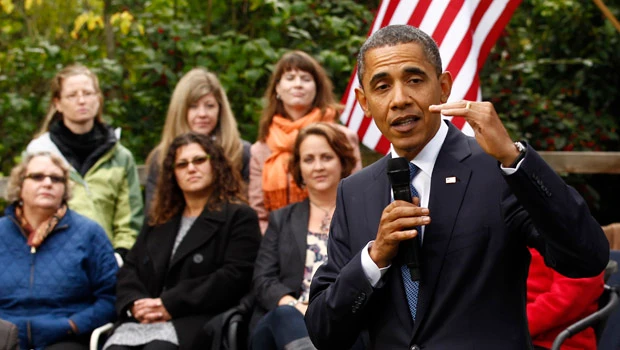
- SEATTLE: President Barack Obama was trying to corral support from women voters Thursday, a key constituency that helped sweep him into the White House two years ago but has drifted toward Republicans in critical elections that could wipe out Democrat majorities in Congress on Nov.
- 2.
Obama is in the midst of his longest campaign swing as president, a four-day trip through Oregon, Washington, California, Nevada and Minnesota. He’s trying to beat back a swelling Republican tide that is cresting on voter anger over slow economic recovery and unemployment stuck near 10 percent.
Drawing a line under Obama’s expected message to women, Valerie Jarrett, one of his top advisers, issued a long statement in Washington early Thursday outlining a report by the White House National Economic Council. She promoted the president’s efforts on behalf of women.
“Since his first day in office, President Obama has focused on laying the foundation for economic growth that creates good jobs and a healthy economy for all Americans,” Jarrett wrote. “Strengthening opportunities for women in our economy is a key focus of the president’s economic agenda.” Obama is not on the ballot in this election, which falls halfway through his presidency, but he is trying to energize Democratic voters against Republicans and their tea party allies who are seen as far more enthusiastic about voting. At stake are all 435 seats in the House of Representatives and 37 of 100 places in the Senate.
Thirty-seven state governorships also are in play.
Republicans are forecast to easily retake control of the House, diminish or even erase the Democrat majority in the Senate and capture a majority of the races to fill governors’ mansions.
Allocating the president’s valuable time is part of the tricky balance for the White House — deploying Obama to the right places to stir up enthusiasm and re-energize first-time voters from two years ago even as he tries to keep people from viewing the election as a referendum on him and the battered economy.
Half of likely voters say how they vote on their House race won’t be affected by Obama at all, according to a new Associated Press-GfK poll. Yet almost as many said they will, in fact, base their House vote in part to send a message about Obama — 26 percent to oppose him, 23 percent to support him.
The president is telling supporters the congressional elections matter. “Unless we are able to maintain Democrats in the House and Senate, then we’re going to be stalled for two years or four years, and we’re going to start going backwards,” he said at one fundraiser this month.
He is referring to the fate of big items Congress already has passed, like health care and Wall Street reform, and promises not yet kept, including deficit reduction and immigration reform.
“We don’t want them rolling back health reform, so insurance companies can deny you coverage because you’re sick. We don’t want them rolling back Wall Street reform, so now credit card companies can go back to hitting you with hidden fees and penalties,” Obama said Wednesday night at a noisy indoor rally in Portland, Oregon, for gubernatorial candidate John Kitzhaber. “We have tried that before and we’re not going back.” Obama began this long campaign swing in Portland, where a crowd estimated at 8,000 people leapt to its feet and erupted into cheers as Obama bounded onto the stage. That was a fraction of the 75,000 people who flocked to a riverfront rally in the city during his 2008 presidential campaign, but still more than the 5,000 people rally organizers had hoped would attend.
Obama’s agenda Thursday includes the economic discussion geared toward women, an appearance for Sen. Patty Murray — who’s in a tight race — and a fundraising event in San Francisco, California.
Obama’s main roles are to raise money for the party, draw votes and media coverage for candidates in tight races, entice volunteers to knock on doors for scores of lesser-known candidates and try to shape the national election debate. He is intent on drawing a contrast between Democratic and Republican leadership of the country and will repeat it everywhere he goes, based on the assumption that it will be fresh to voters in Minnesota even if he just said it in Maryland.
His 2008 presidential campaign manager, David Plouffe, said Obama may well not be able to change the dynamic of a race in which a candidate is trailing by 8 to 10 points, but he could be a key factor if the margin is 51-49.
“The central actors in the election are the candidates themselves,” Plouffe said. “It’s how they handle the last two weeks that’s most important.” Obama, though, is at the center of reminding voters that this election and the issues it will shape are an extension of his own win in 2008.
“I know that there are times where probably it’s hard to recapture that sense of possibility,” Obama said in Ohio this week. “It’s hard sometimes to say, ‘Yes, we can.’ You start thinking, ‘Well, maybe, I don’t know.’ It’s not as inspiring a slogan. But I said during the campaign, this has never been easy.”