
- BEIJING: Japan and South Korea moved on Friday to reduce their dependence on China's rare earth metals amid fears export reductions by Beijing could be the trigger for a broader trade conflict as nations joust over currencies.
Reports this week that China halted shipments of rare earths to Japan during a sea territory dispute raised fears that China could use its global dominance of supplies as a political lever.
China denied reports it planned to slash export quotas, but with more than 90 percent of the global production of rare earths coming from China, the reports triggered alarm.
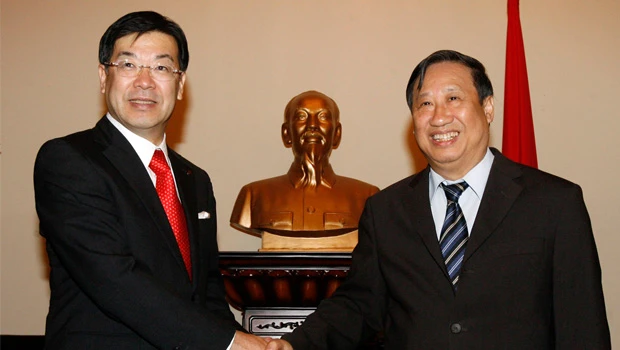
In Tokyo, Trade Minister Akihiro Ohata said Japan wanted to conclude a development program with Vietnam for rare earths, used in autos, computers, cell phones and other products.
"Vietnam is a very promising place, and naturally I am strongly hoping for a joint development of rare earths," Jiji news agency quoted Ohata as saying.
The Nikkei business daily had earlier said Japanese Prime Minister Naoto Kan would meet his Vietnamese counterpart, Nguyen Tan Dung, on Oct. 31 in Hanoi to agree on a development scheme.
Former Prime Minister Yukio Hatoyama left for Vietnam on Friday to discuss possible cooperation in rare earths and infrastructure development, Hatoyama's office said.
Bloomberg, meanwhile, said South Korea wanted to cooperate with Japan and the United States to develop alternative sources.
In Geneva, the World Trade Organization said it would not publish a ruling in a dispute brought against China over exports of rare earths until next April instead of this year.
The chairman of the panel examining the cases said in a statement on the WTO website the panel expected to complete its work by April. The panel gave no reason for the delay, but said it had been agreed with the parties to the dispute.
The United States, European Union and Mexico launched a dispute at the WTO last year, saying Chinese export restrictions on the rare minerals discriminated against foreign manufacturers and gave an unfair advantage to domestic producers.
Japanese trading houses Toyota Tsusho Corp. and Sojitz Corp. are already preparing for rare earth development in Vietnam, while Sumitomo Corp., another trading firm, aims to start rare earth shipment to Japan from Vietnam as early as 2013, the Nikkei said.
Sumitomo and Sojitz said plans were still in early stages.
Bloomberg quoted Kim Sang Woo, a deputy director at the Minerals Resources Division of South Korea's Knowledge Economy Ministry, as saying he expected China would maintain export caps and increase stockpiles to meet higher demand.
Sun Zhenyu, ambassador to the World Trade Organization, told Reuters Insider that China's own stocks of the rare metals were falling fast and had to be conserved.
"I think there will be probably not a very quick change in the export quota mechanism of rare earths," Sun said in an interview on the trade implications of the five-year-plan, unveiled this month.
China's media has accused Western countries of making unreasonable demands over the cheap supply of rare earths.
"Rare earths are a commodity. Each country has the right to decide how much it exports or imports. This is normal economic behavior," the People's Daily said.
"China has the absolute right to decide for itself how much rare earths it can export and produce."
But any cut in exports could rattle firms that use the metals. A slowdown in shipments may reflect a drop in export quotas, which has left over-committed traders scrambling to cover orders placed in the first half of the year, analysts say.
The rare earth concerns come as G20 finance officials meeting in South Korea struggle to reach an agreement to tackle global economic imbalances and fend off the prospect of damaging currency devaluations.
Many countries gave a cool reception to US proposals to set limits on current account balances to defuse tension over currencies that economists fear could trigger trade wars.
Experts say Vietnam is a key channel for smuggling rare earths and other minerals out of China.
About 20,000 tons of rare earths were smuggled out of China in 2009, according to a note by Eurasia Group analyst Damien Ma, supplementing legal exports through that year's quotas of about 50,000 tons.