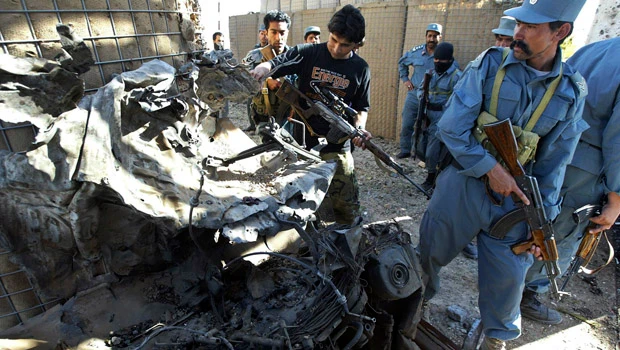
- HERAT, Afghanistan: Four Taleban suicide bombers dressed as women and police attacked the main United Nations compound in western Afghanistan on Saturday, but there were no casualties among UN staff, officials said.
The attack was launched on the compound in Herat, a commercial hub and the largest city in the country’s west where Taleban and other Islamist fighters are usually less active.
It was the highest profile attack on the United Nations since last year and will raise questions about security in a city that NATO officials believe could be among the first to have security responsibility handed from foreign troops to Afghan forces.
“The incident is over and there are no UN casualties,” said Kieran Dwyer, chief UN spokesman in Kabul.
One attacker exploded a car bomb at the gates of the compound, two more blew themselves up and a fourth was shot by police inside the compound before he could detonate his bomb, Herat governor Mohammad Dawood Saba said.
Some were dressed in all-encompassing burqas worn by many Afghan women and others were in police uniforms, police said.
Despite the presence of 150,000 foreign troops, violence from Afghanistan’s war against the Taleban is at its most intense since the conflict began in 2001 when US-backed Afghan troops ousted the Islamists from power.
The conflict is weighing on US President Barack Obama and his NATO allies as foreign troop casualties mount and Washington looks to start bringing back troops from July next year and steadily hand over security to local Afghan forces.
One of Afghanistan’s largest cities, with a population of about 3 million, Herat is under the regional command of Italian troops and has enjoyed relative calm compared with more restive parts of the country.
Earlier this year, NATO’s regional commander said districts within Herat were ready to transfer security responsibility to local forces.
No ground troops from the NATO-led International Security Assistance Force (ISAF) were involved, but an ISAF helicopter was circling overhead monitoring the incident, ISAF spokesman Major Michael Johnson said.
A local Taleban commander, Mullah Bilal, claimed responsibility for the attack on behalf of the group. One fighter had blown himself up and others had entered the compound, he told Reuters.
It was the worst attack against the United Nations since October 2009, when militants attacked a UN guesthouse in Kabul and five foreign UN staff were killed. That attack prompted the United Nations to evacuate hundreds of foreign workers.
In a report on Afghanistan in June, the UN said the organization was still a potential target for militant attacks, and it would be cutting the size of its international staff.
Insurgents have stepped up attacks beyond their strongholds in the south and east of the country. More than 2,000 foreign troops have been killed since the war began, more than half of those in the past two years.
In the south, a photographer for The New York Times was seriously injured by a mine Saturday in Kandahar province where international forces are pushing into Taleban strongholds to try to turn the tide of the war.
Joao Silva, 44, received leg injuries when he stepped on the mine while accompanying American soldiers on patrol in the Arghandab district. Silva was evacuated to Kandahar Air Field where he was receiving treatment, the newspaper said in a statement.
No US troops were wounded in the morning explosion.
A group of minesweepers and bomb-sniffing dogs had just moved over the area and were several steps ahead of Silva when the bomb went off. Homemade bombs and mines cause the majority of deaths and injuries among US and NATO forces in Afghanistan. Bombs made with small amounts of metal are difficult to detect.
Silva and a New York Times reporter were embedded with a unit of the 101st Airborne Division.
Silva, who has received several awards for his work, has photographed wars in Afghanistan, Iraq, southern Africa, the Balkans and the Middle East. He is the author, with Greg Marinovich, of “The Bang-Bang Club,” a chronicle of a group of four photographers covering the violence in South Africa in the 1990s. The other two were Kevin Carter and Ken Oosterbroek.
“Joao is the state-of-the-art war photographer, fearless but careful, with an amazing eye,” said Bill Keller, executive editor of The Times. “We’re all waiting anxiously and praying for his quick recovery.”
In August 2009, CBS Radio News correspondent Cami McCormick was seriously injured when the Army vehicle in which she was riding struck a bomb south of Kabul. That same month, two journalists for The Associated Press — photographer Emilio Morenatti and videographer Andi Jatmiko — were wounded along with two US soldiers by a bomb — also in Kandahar province.