
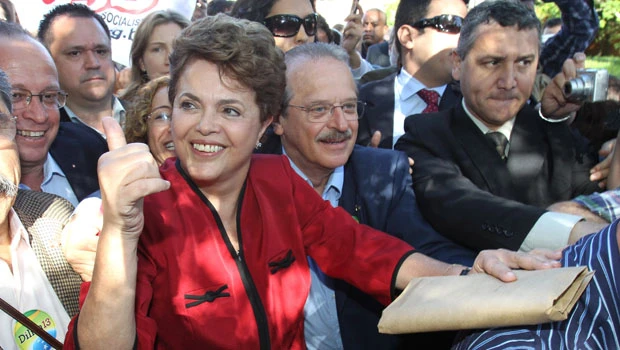
- SAO PAULO: The hand-picked candidate of Brazil’s hugely popular president was poised to replace him as leader of Latin America’s biggest nation as voters began casting ballots Sunday in a runoff election.
Dilma Rousseff, a 62-year-old former Marxist guerrilla and career bureaucrat who long ago left behind her rebel ways, held a comfortable lead in opinion polls and was bolstered by the support of President Luiz Inacio Lula da Silva, her political mentor, in the contest with centrist Jose Serra.
The winner will lead a nation that will host the 2014 World Cup and is expected to be the globe’s fifth-largest economy by the time it hosts the 2016 Summer Olympics.
Just hours before polls were to open, Rousseff paid tribute to Silva and assured Brazilians that while he would not have an official role in her government, he would always be near.
“President Lula, obviously, won’t be a presence within my Cabinet. But I will always talk with the president and I will have a very close and strong relationship with him,” Rousseff said at a final campaign stop in her hometown of Belo Horizonte. “Nobody in this country will separate me from President Lula.” Silva, after two four-year terms, is barred by Brazil’s constitution from running for a third. He maintains an 80-percent approval rating and has a rabid following among the nation’s poor, who view the former shoeshine boy who came from an impoverished family as one of their own.
Silva’s generous social programs have helped pull 20 million people out of poverty and thrust another 29 million into the middle class since he took office in 2003.
Rousseff, who would be Brazil’s first female president, pledged to continue Silva’s work.
“I want to unite Brazil around a project not just of material development, but also of values,” she told supporters at the rally. “When we win an election, we must govern for all Brazilians without exception.” Early Sunday, Rousseff cast her vote in southern Brazil, where she is registered, flashed a victory sign and big smile to photographers and left without making a statement.
Serra, a 68-year-old former governor of Sao Paulo state and one-time national health minister who was badly beaten by Silva in the 2002 presidential election, said the election was far from over and criticized what he said would be Rousseff’s heavy reliance on Silva to help rule.
“We know that nobody can govern in the place of another,” Serra said in a final campaign stop, also in Belo Horizonte. “Whoever is elected has to govern. The outsourcing of a government does not exist.” Yet Silva clearly casts a shadow over the political landscape. Even Serra promised that if elected, he would not “ostracize” Silva because of the leader’s “immense political capacity.” Silva entered office as a former labor leader but he governed from a moderate perspective. Under his leadership, the economy grew strongly and Brazil weathered the global financial crisis better than most nations, giving many a strong desire for continuity by backing Rousseff.
In the first round of the presidential election Oct. 3, Rousseff got 46.9 percent of the votes, falling just short of the majority she needed to avoid a runoff ballot. Serra finished second with 32.6 percent.
The wildcard candidate was the Green Party’s Marina Silva, a former environment minister and no relation to the president, who took 20 million votes in the first round, leaving Rousseff and Serra to scramble for her supporters during the second round.
The respected Datafolha polling institute said Friday that about 48 percent of Marina Silva’s voters reported planning to vote for Serra — more than the 27 percent who are now supporting Rousseff, but not enough for him to win.
Overall, Datafolha gave Rousseff 50 percent supporter among voters against Serra’s 40 percent. The poll interviewed 4,205 people in 256 counties across Brazil on Thursday and had a margin of error of plus or minus two percentage points.
“I don’t expect any great changes, I just want her to continue Lula’s work,” said Jacqueline Sales, a 24-year-old design student in Sao Paulo, who supports Rousseff.
Serra backer Julio Brochieri, a 28-year-old Sao Paulo bank worker, said he feared Rousseff would govern to the left of Silva. He also expressed concern about her political abilities, since she has never held an elected office.
“Serra has more experience and will handle the economy better,” Brochieri said. “Rousseff will be more interventionist in the economy and that worries me.” Serra and Rousseff — both economists by training — have been active participants in Brazil’s political transformation following the 1964-85 military dictatorship.
Rousseff was a key player in an armed militant group that resisted the dictatorship and was imprisoned and tortured for it. She is a cancer survivor and a former minister of energy and chief of staff to Silva.
Serra also battled the dictatorship, but through politics rather than armed resistance. He headed a national student group that opposed the regime and was forced into exile in Chile in 1965 before heading to the US, where he earned a doctorate in economics at Cornell.
Under President Fernando Henrique Cardoso, Silva’s predecessor, Serra served as planning minister, then health minister, winning praise for defying the pharmaceutical lobby to market cheap generic drugs and free anti-AIDS medicine.
About 135 million voters will cast ballots Sunday.
Under Brazilian law, voting is mandatory for citizens between the ages of 18 and 70. Not voting could result in a small fine and make it impossible to obtain a passport or a government job, among other penalties.