
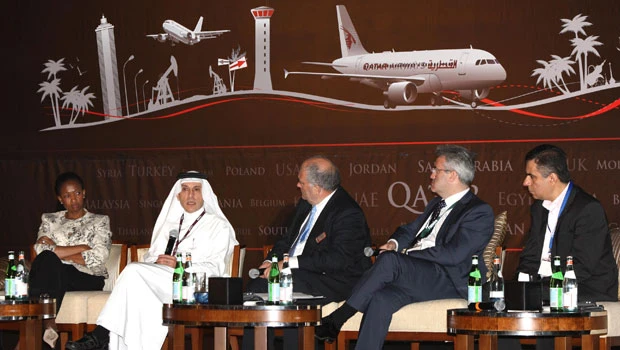
- DOHA: The Doha Aviation Summit being held here has focused on the need for industry collaboration to fight off the introduction of unnecessary charges that will eventually have to be passed onto consumers.
Industry bodies International Air Transport Association (IATA) and International Civil Aviation Organization (ICAO) should work collectively in the interests of airlines, a speaker on a panel of airline executives said during the summit on Saturday. The European Union (EU) is looking to introduce new charges relating to the environment, which will eventually be borne by airline passengers.
“IATA and ICAO should realize how much dependence the world economy has on aviation,” Qatar Airways CEO Akbar Al Baker said in the panel discussion. He cited the proposed European Trading Scheme (ETS) allowing the EU to press ahead with plans to charge airlines flying in and out of European airspace for emissions permits from 2012.
ETS forces the aviation industry to pay for permits for each ton of carbon dioxide they emit into the atmosphere. The ETS is the EU’s main tool for combating climate change and it wants to see the system adopted worldwide. Challenging such a scheme, Al Baker said these charges were merely designed to fund governments and not necessarily find their way back into the industry — and that consumers would be forced to pay for these charges to the detriment of the industry as a whole.
“Governments should not be using airlines as a cash cow for their own inefficiencies. They should try to work with airlines for the benefit of trade and commerce,” Al Baker said, adding that one industry voice to tackle the issue was the way forward.
Al Baker also addressed the growing discontent among European airlines about the rapid growth of Gulf carriers. “In order to put their own house in order, they are trying to blame us for their shortcomings,” he said. “They should be more efficient. They are worried because we are very cost focused, yet airlines in Europe are cost constrained and not allowed to grow because of their high cost base.”