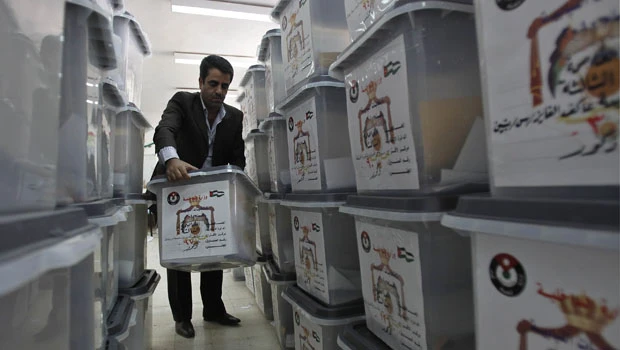
- AMMAN: About 2.4 million Jordanian voters go to the polls Tuesday to choose a new lower house of Parliament amid boycott by the country’s main opposition grouping, the Muslim Brotherhood and its political arm, the Islamic Action Front (IAF).
A total of 763 candidates, including 134 women, will be competing for the house’s 120 seats, 12 of them are set to be won by women in accordance with the feminist quota system.
Many of the candidates have been fielded by their own tribes, families and factional interests in preliminary local elections and have been campaigning with individual slogans that came without any systematic program. Most of election slogans focused on local economic and social issues with few candidates opting to refer to the Arab-Israeli conflict and Iraq.
Official records indicate that 86 candidates are running under the umbrella of political parties and seasonal gatherings, but local columnists suggested that most of them were relying on tribal and family backing to ensure seats under the dome.
The polling process is conducted on the basis of a new controversial one-person-one-vote law which sought to plug loopholes in the previous legislation that previously facilitated a variety of election fraud, including vote buying, but excluded the proportional representation system.
The IAF and the allied left-leaning Popular Unity Party (PUP), rejected the new law and decided to boycott the polls, saying the government failed to provide adequate assurances that the new elections would not be “rigged” as happened in the 2007 polls when the IAF won only six seats, compared with 17 in the earlier chamber.
The state-funded National Centre for Human Rights (NCHR) seemed to support the Islamists’ viewpoint when it confirmed that the 2007 polls had witnessed certain “irregularities.”
Apparently against this backdrop, King Abdallah decided in November to dissolve the outgoing House of Representatives, two years before the completion of its four-year term amid reports that the chamber had failed to perform his legislative and supervisory functions in a proper manner.
Prime Minister Samir Rifai pledged to hold “fair and transparent” elections, but failed during two sessions of dialogue to sway Islamic leaders to back out on their boycott decision.
“We hope that our boycott of the polls will prompt the government to embark on real political reforms, including the adoption of a proportion representation election system,” IAF Secretary General Hamzeh Mansour told Arab News.
“We think the priority now should be given to reforms, because the executive branch of the government has been riding roughshod on the Legislature since the adoption of the partial one-person-one-vote system in 1993,” he added.
Rifai said that changing the election system would be the responsibility of the new lower house, but Mansour insisted that the chamber would be a “reflection” of the government and would not be able to adopt such reforms.
However, the government was at pains to affirm its impartiality in the polling process.
“The government stands at the same distance from all candidates and has no interest in supporting any of them,” Interior Minister Nayef Qadi said.
Despite the IAF’s boycott of the elections, seven of its members have decided to run, but the concerned party tribunal decided to expel them, igniting a deep controversy inside the only Jordanian party organized on the Western pattern of political action.
The election campaign, which lasted for one month, was marred by reports of election fraud, including vote buying, which drew concern from human right groups and the press.
The NCHR urged the government to shoulder its responsibilities in strictly applying the new law, which provides for a seven-year jail term for all those involved in vote buying.
But spokesman for the Elections Committee, Samih Maayta, insisted that all cases referred to the public prosecutor turned out to “lack evidence”.