
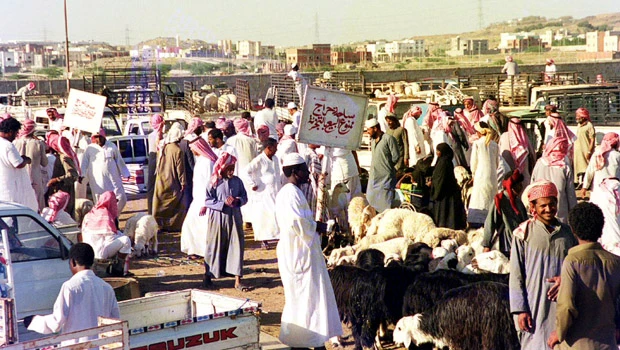
- JEDDAH: Members of the Saudi public believe that government subsidies for fodder is a waste of resources because livestock prices in the country still remains high.
The Ministry of Commerce and Industry decided to subsidize fodder to control rising prices of livestock and keep them affordable. However, consumers complain that cattle breeders refuse to cut prices even after receiving fodder at subsidized rates.
“Subsidies for barley is not leading to lower prices in the cattle markets and therefore they should be stopped,” said consumer Folail Al-Hujjaji.
The price of barley, which spiraled to SR53 per bag three years ago, came down after the subsidies were introduced, Al-Hujjaji said.
Cattle breeders have used the subsidies to maximize their profits by continuing to increase prices, said Al-Hujjaji.
“The present livestock price is unjustifiable. Before the prices of fodder started rising three years ago, the average price of a camel was SR1,800,” he added.
But despite the price of fodder returning to its old level, the price of a camel has risen to SR4,000. The price of a Harri sheep has increased from SR500 to SR1,300 and a Sawakni sheep now costs SR950 against SR350 earlier.
Fellow citizen Muslim Al-Dosary agrees that the subsidies have proven useless for consumers. “These greedy traders do not deserve subsidies. They are supposed to pass on the savings they make to consumers, which they never do,” he said.
“They pocket the subsidy and sell their products at an inflated price, as is also the case with rice, sugar and flour. The government is keen to help the common man by giving subsidies, which are then abused by greedy traders.”
Nasser Al-Suweilih believes subsidies should be given only to rural livestock breeders who depend on the cattle for their livelihood and not to large-scale breeders who are more likely to keep their prices high.
Saleh Al-Sinani, a Saudi sheep trader, said sales of sheep, at SR1,350 per head, have been slow despite Eid Al-Adha approaching. “Demand for our sheep is down because people are now looking for cheap sacrificial animals supplied by Islamic Development Bank and other charity organizations,” he said.
A source at the Ministry of Commerce and Industry said it planned to publish a price index for sacrificial animals in domestic markets in all provinces as Eid Al-Adha approaches.

