
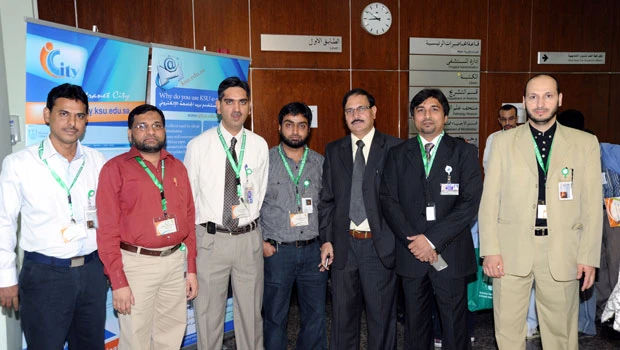
- RIYADH: The King Khaled University Hospital (KKUH), a 800-bed health facility, marked an Information Technology Day in Riyadh on Sunday.
The event was organized to generate IT awareness among the hospital’s staff and also among health personnel at other hospitals.
“Preventing medical errors and improving patient safety are among the most important potential advantages of adopting IT in health care, a message which the event sent across,” said Salman Khaled, systems administrator at King Saud University (KSU) hospitals. KKUH is operating under the Riyadh-based KSU.
Khaled said several IT events were staged during the day. Some research papers were also presented on the theme of IT awareness. The College of Medicine and an intranet portal, ICITY, were also launched.
Prominent organizers and speakers included Mansour Al-Swaidan, KKUH’s IT chief, and his deputy Khawla Al-Harbi.
Khaled said studies about the use of IT tools have demonstrated that the use of individual IT applications, such as computerized order entry and clinical decision support systems, are associated with desirable health outcomes.
“Hospitals may be able to significantly reduce the time it takes to dispense medications to patients and complete X-rays and lab tests by having physicians fill out orders via computer rather than paper,” said a study conducted by Ohio State University.
The results of the study showed that computerized ordering also eliminated prescription drug errors that occurred when doctors' handwritten prescriptions were misread.
“Digitizing physician orders cut turnaround times for medication by 64 percent, X-rays and other radiology procedures by 43 percent, and lab tests by 25 percent,” said the study.
Moreover, computerized physician order entry enhances patient care by improving work flow and efficiency, and reduces transcription errors.