
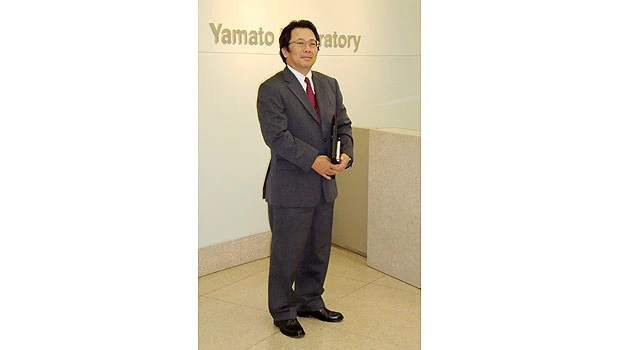
- Driving up to Lenovo’s R&D center in Yamato, Japan, it’s disconcerting that the “IBM” adorning the building is the most prominent branding at the site.
- No, this isn’t some sort of time warp.
With an unofficial title of “Father of the ThinkPad,” Naitoh is extremely proud of the notebooks he has created. He pointed out that after 18 years and 60 million ThinkPads shipped, in the five years since Lenovo acquired IBM’s Personal Computing Division, more ThinkPads have been sold than ever before. Lenovo’s number of units shipped has grown faster than any other PC vendor for the last four consecutive quarters. That growth is coupled with excellent customer satisfaction. In September it was revealed that Technology Business Research (TBR) had ranked Lenovo ThinkPad laptops number one in its “Corporate IT Buying Behavior and Customer Satisfaction Study” for 2Q 2010. The ranking was the fifth time in a row that medium and large business customers surveyed by TBR had recognized ThinkPad notebooks as the leader in overall satisfaction. Lenovo ThinkPad laptops took the top spot in seven of the past ten TBR Customer Satisfaction Study reporting periods.
If as an individual in Saudi Arabia you’ve never considered buying a ThinkPad, and perhaps don’t even recognize the Lenovo brand, it’s no surprise. Outside of China, the company has had a focus on selling to businesses, particularly the large enterprise sector. In buying mobile computers, large companies have different priorities than small companies or individuals. Enterprises are very concerned with consistency in the “build,” which Lenovo does well. This means that when an enterprise buys Lenovo notebooks to serve across their entire operation, that the specifications and configurations of the selected hardware, software and systems will be exactly the same on Lenovo notebooks delivered to that firm’s offices anywhere in the world. Corporate notebooks tend to be heavily abused. Companies want a tool which will reliably produce business value throughout the corporate computer’s life cycle of 110 days. They don’t care if the notebooks’ case is colorful or the keyboard has a contemporary look. Companies want notebooks to survive employees who spill coffee on them and drop them on the floor. Plain black notebook exteriors are usually perfect.
Naitoh believes he knows better than anyone what business customers want and he thinks that what they don’t want right now are slate or tablet computers similar to Apple’s iPad.
“Tablet computers are only good for users who consume information, not for content creators,” he said. “I can’t think of one person on my team who would prefer a tablet computer over a notebook.”
According to Naitoh, it’s hard to imagine an executive who could survive away from the office for two weeks with just a tablet computer and a phone. Personally, he’s not willing to haul around another piece of equipment. On his commute to and from the office, he already has to carry his personal mobile handset, a Blackberry and a notebook. He uses the Lenovo T410 because he prefers a 14-inch screen to something smaller.
If Naitoh thinks slates are inadequate for business users, how about a 3D ThinkPad coming out in the near future? Don’t count on it.
“Unless it’s really useful in business, I’m not creating it,” he advised. “Entertaining is not our focus.”
Naitoh thinks that currently the best computer to produce for businesses interested in slate computers would be something similar in concept to Lenovo’s IdeaPad U1 hybrid scheduled to ship in January. The U1 is a Windows 7 netbook, that will run Android on the slate portion of the machine which undocks from the keyboard. It’s designed for personal use. Naitoh envisions that such a combination, with more powerful specifications, is the “most reasonable to implement in the short term” as a notebook/slate business offering.
Another change that may be coming to ThinkPads is sealed-in batteries. Such a concept would have been problematic a few years ago. But Naitoh remarked that the newest batteries — lithium-polymer cells — are designed to last for at least three years, if not longer. That’s more time than most business users keep their laptops. Without the bulk of a battery compartment and its connector, a laptop can be thinner and lighter. For Naitoh, lighter means designing the notebook to be under 1.2 kilos. He explained that in countries such as the USA where business users tend to drive rather than take public transportation, a two kilogram notebook is not a problem. In Japan though, and other countries where everyone relies on public transportation, two kilos is too heavy. More needs to be done to bring down average notebook weight and sealed-in batteries would be a help with that issue.
For the future also expect to see more ThinkPads in which portions of the notebooks are molded together. Once again, this saves on weight and such techniques will also enhance the durability of the equipment since there aren’t connectors to fail. Top of the line carbon fiber cases will continue to be the most robust and most expensive, and don’t imagine that optical disc drives are disappearing soon. Lenovo’s market research shows that companies purchasing notebooks above 13-inches want the optical drive, despite the added weight.
Lenovo’s market research also shows that the PC vendor is missing out on significant opportunities in the small business and consumer sector because individuals don’t find ThinkPads as desirable as enterprises. Long a consumer brand in China, Lenovo has plenty of experience marketing to individuals and the company plans to increase its promotion of its IdeaPad products worldwide. These computers span the range from laptop to netbook and are considered to be lifestyle products rather than workhorse PCs.
Sadly, such segmentation of products creates a quandary for women who use notebooks as essential business tools. Do they buy the IdeaPad with the lovely floral design and worry that it won’t hold up to aggressive use or do they purchase a ThinkPad and feel displeased with its matte black exterior every morning? With Naitoh moving soon to a new R&D facility in Yokohama, there must be hope that fresh surroundings may inspire him to create a ThinkPad that’s both sexy and durable.