
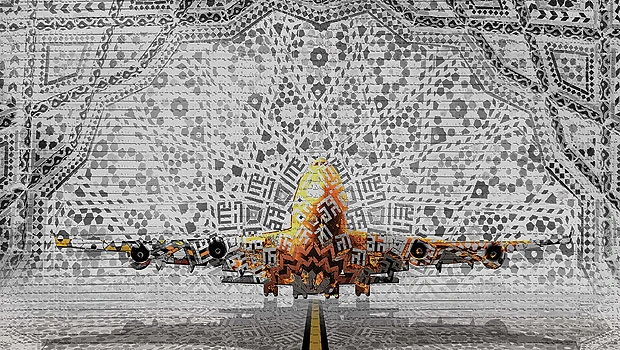
- A man with a transcendent vision and a remarkable skill to convey his thoughts through artwork and imagery, Abdulnasser Gharem is driven to go beyond the borders of his mind, his environment and without a doubt, his canvas.
Born and raised in Khamis Mushayt in 1973, Gharem is presently a practicing conceptual artist, as well as a lieutenant general in the Saudi Arabian Army.
At his exhibit in the Abu Dhabi Art fair and to my pleasant surprise, I didn’t find a showcase of cliché watercolor-on-canvas pieces. Instead, I walked into a silent, yet powerful “East meets West” dialogue — images that were conversing with one another, while engaging their audience in this interchange.Though some of the works may have struck as political at first glance, a closer look uncovered a world of meticulously chosen materials, metaphors and symbols. Using media that ranges from rubber stamps to industrial concrete, Gharem’s conventionalism was not only apparent through his art, but also through his methods and novel approach in delicately conveying the strongest of messages.
Gharem graduated from King Abdulaziz Academy in 1992 before attending the Leader Institute in Riyadh. He started off as a classical artist; and in 2003, he continued to pursue his interests at the Al-Miftaha Arts Village in Abha. As he witnessed the growth of the Internet, he was finally able to access the works of artists in other parts of the world. His classical ways soon took a turn to the conventional.
“I found out that drawing and painting weren’t enough to convey my ideas. When I started researching what the rest of the art world was doing, which is engaging in video art, installations and performance art, I started to teach myself. I am a self-taught artist,” he said.
His discoveries inspired him to create pieces that spoke for themselves, initiating somewhat of an open-ended dialogue where viewers would make their own connections and conclusions rather than being told what they should see. When asked about his sources of inspiration, Gharem explained that he retrieves them from his daily life, people, places and even from the media.
“My artwork isn’t only a reflection of my opinion; I depend on the people around me for inspiration. I’m not the type of artist that sits in a studio and daydreams about what to draw. My inspiration is from my daily life, and everything in it,” he added.
One aspect of Gharem’s art is the use of industrial concrete. He explained its significance by recalling an event that he experienced while living in Abha in 1982. One day, upon hearing news of heavy incoming rains and a possible flood, the residents of a nearby valley went into panic. One of the townsmen suggested that the safest place to retreat would be one of the town’s main bridges. Without hesitance, the people gathered their families, cars and belongings and fled there for safety. The bridge split in half when the flood came through, and consequently, everything on it was wiped out.
“This is why I say don’t put your trust in the concrete. These people lost their lives; not one of them decided for themselves or tried to find a more concrete solution. The moral of this event set the tone for all of my works,” he said.
Gharem later went back to that same bridge to create one of his favorite installation works, titled “The Path.” Further explaining the inspirations of his art, Gharem used the example of concrete blocks that surrounded the American Embassy in Saudi Arabia after the Sept. 11 incident.
“I’m not saying it’s wrong. I’m not here to impose my opinion on what’s wrong or right. I’m just saying that instead of using these physical and metaphorical blocks, we should work together to reach a common ideology by brainstorming and discussing, rather than using borders,” he said.
Gharem also uses rubber stamps in many of his pieces and explains that many countries and their governments depend on the use of stamps. “Each individual has their own stamp in the world even doctors, engineers and journalists. If you don’t have a stamp, you don’t exist. I wanted to show my audience that they are part of this conversation as well,” he said.
He also expressed the idea that although some people speak about truth, justice and peace, their truth is oftentimes “stretched,” just like rubber stamps. “My goal is to trigger a discussion, to open people’s eyes and stimulate them to seek their own truth. It’s a kind of noble speech to the people.”
Images transcend the boundaries of space, time and the spoken language. Many renowned artists of the past were well aware of this phenomenon. Unlike then, however, we are now constantly surrounded by different imagery in television, billboards, magazines and even in our homes. Facebook, Twitter, and various other social media applications have shifted the power to the people and made the transmission of images and information available to the world at the click of a button.
“There are no more borders, so it makes it hard to contain what people are exposed to. That’s why it’s important to transmit your message in a diplomatic and noninvasive way … there’s no need for causing a clash or any sort of friction.”
Using imagery and art to convey thoughts — regardless of how controversial they may seem — is a much more powerful means of expression. Gharem sees the world through the perspective of a “global society,” and believes that it’s each individual’s responsibility to think for themselves, educate themselves and make their own decisions. If we all blindly follow the “shepherd,” we will end up going down a road that has been traveled many times before. The pen is sharper than the sword, but an image can create a borderless conversation — even if it were a rubber stamp.