
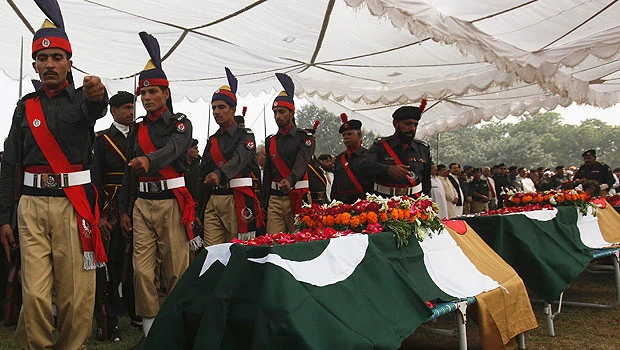
- KARACHI: Militants who attacked a police facility in the heart of Pakistan’s largest city were attempting to free comrades they believed were detained there, a senior minister said Friday.
The coordinated assault late Thursday in Karachi, using a car bomb and guns far from Taleban and Al-Qaeda heartlands along the Afghan border, showed the ability of militants to strike back despite being hit by US drone strikes and Pakistani army operations.
A gang of around six gunmen managed to penetrate a high-security area of Karachi that is home to the US Consulate, two luxury hotels and the offices of regional leaders. They opened fire on the offices of the Crime Investigation Department before detonating a huge car bomb that leveled the building and others nearby.
The police offices housed a detention facility that was believed to be holding criminals. The CID takes the lead in hunting down terrorists in Karachi. Earlier this week, the agency arrested six members of Lashkar-e-Jhangvi, an Al-Qaeda linked group blamed for several attacks in recent years. The suspects were presented before a court earlier Thursday.
“The terrorists were well prepared and they had came here to rescue their associates. But under a strategy, we had not kept those men at this building. So their plan failed,” said Qaim Ali Shah, the chief minister of Sindh province, of which Karachi is the capital.
He did not say how he knew that the gang were attempting a rescue and not simply attacking the building, the type of strike that militants in Pakistan have often carried out in the past. He and other officials have not said whether the attackers escaped or where killed in the blast, which left a crater 10-feet wide in the floor. Karachi police said that activists from Jhangvi and Tehreek-e-Taleban Pakistan (TTP) had been rounded up in recent weeks.
“We detained at least 10 suspects from the bomb site and the nearby impoverished neighborhoods,” one security official said.
“We think they have links with TTP and Lashkar-i-Jhangvi.
“We have arrested quite a large number of suspects in the last few months from Karachi and it shows that these groups have penetrated into the city. It seems as though these people have gained strength in Karachi.”
Pakistan’s reluctance to mount another major offensive against the Taleban may be due to its fear of equally deadly reprisals by the militants, which erode the government’s credibility among its people, analysts say.
Last year, Pakistan launched two major offensives against militants linked to Al-Qaeda and Taleban in the northwest bordering Afghanistan and the United States has been pushing it to mount another one in their last bastion, North Waziristan.
North Waziristan is a major base for Afghan militants fighting Western forces across the border which critics say Pakistan sees as a bargaining chip for any eventual solution of the Afghan problem once US troops leave.
But analysts say reprisal attacks by militants would be more lethal if the military goes into North Waziristan. “There would definitely be more retaliation if they go into North Waziristan because the strongest militant groups are sitting there and this is also a factor of reluctance to launch operation there,” security and political analyst Hasan Askari Rizvi said.
Violent reprisal attacks by militants have taken a heavy toll on civilian lives and they sap what scant support an alliance with the US against militants exists in Pakistan.
The Pakistani state still distinguishes between militants who attack inside Pakistan and those who focus on fighting US troops in Afghanistan or Indian rule in the disputed Kashmir region, believing the latter to be “good” militants. Critics say this policy is shortsighted, noting that groups are increasingly coalescing and support each other.

